What Prediction Markets Say About the 2026 Midterm Elections
See what prediction markets say about the 2026 midterm elections, including control of Congress, key House and Senate races, and what could move the markets.
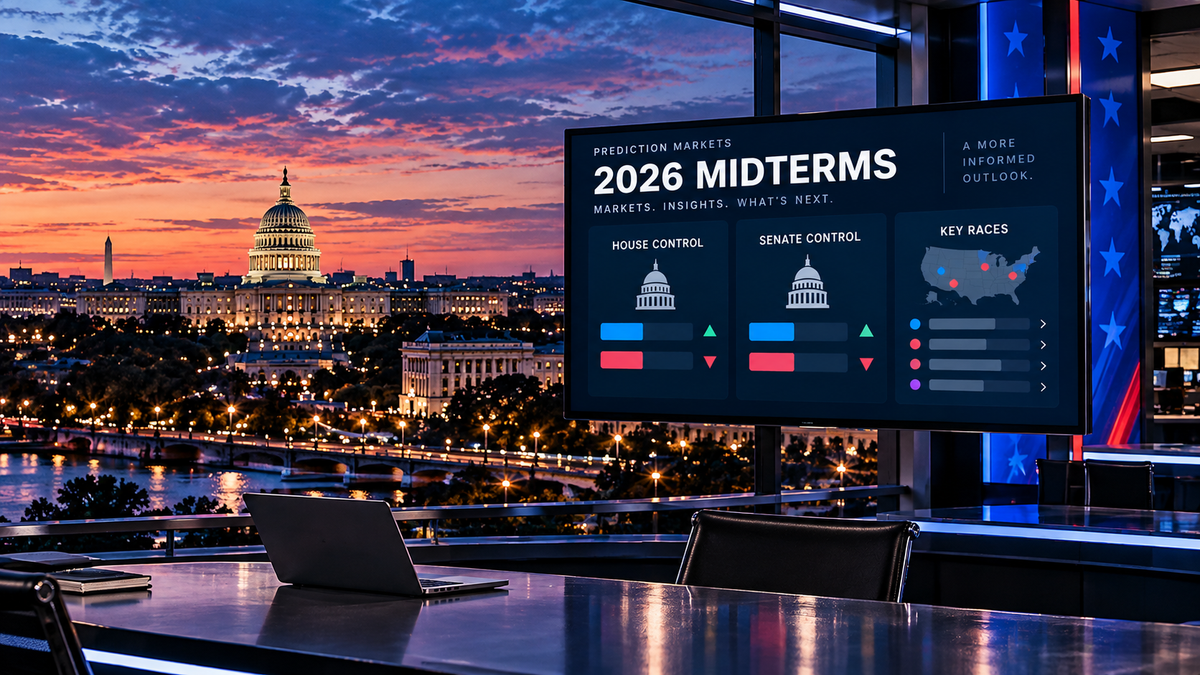
Who will control Congress after the 2026 midterms? Which races could decide it? And where could the biggest surprises emerge?
Prediction markets are putting live prices on those questions and much more ahead of Election Day. Traders can follow control of the House and Senate, individual races, governors, party nominees, ballot measures, and other outcomes across the 2026 election landscape.
Here's what the markets are saying now, the races worth watching, and what could change before voters head to the polls.
2026 midterm election prediction markets
The biggest 2026 midterm markets center on the balance of power in Washington. Contracts on control of the House and Senate provide the headline probabilities, while individual congressional races offer a closer look at the contests that could determine those outcomes.
Kalshi and Polymarket currently offer two of the broadest midterm market lineups. Kalshi's dedicated Midterms Hub combines market prices with polling averages, fundraising data, and related news, while Polymarket organizes its 2026 election markets around congressional control, individual races, and other outcomes.
Trading activity has already reached significant levels. More than $100 million has been traded across 2026 midterm election markets, with activity spread across dozens of contracts and outcomes.
The markets are best read together. National contracts provide the headline probabilities, while individual races help show what could produce those outcomes. As polling, candidates, fundraising, and other information change, prices across the board can move with them.
Control of Congress markets
Prediction markets currently point to two very different races for control of Congress: Democrats are heavily favored to win the House, while the Senate is essentially a toss-up.
The House is the clearer side of the board. Democrats are trading at an 85% chance to win the chamber on Kalshi and 89% on Polymarket. That leaves Republicans as sizable underdogs to maintain their current House majority.
The Senate is much tighter. Kalshi currently prices Republicans at 51% and Democrats at 49%, while Polymarket also shows a virtually even race. With Republicans defending a 53-47 advantage, control of the chamber could come down to a small group of competitive races.
Put the two chambers together, and a Democratic sweep is now the single most likely outcome in the balance-of-power markets. It's priced at 46% on Kalshi and 50% on Polymarket, narrowly ahead of a Democratic House and Republican Senate at 39% and 35%, respectively. A Republican sweep trails at 16% on Kalshi and 12% on Polymarket.
The picture is clear in one chamber and unsettled in the other. Prediction markets expect the House to flip, but the battle for the Senate could determine whether the midterms produce divided government or a Democratic Congress.
2026 House and Senate races to watch
The national markets show which party is favored to control each chamber. The individual races show where those probabilities could change.
A handful of Senate contests stand out as especially important:
- North Carolina: Democrats have a major pickup opportunity in the race to replace retiring Republican Sen. Thom Tillis. Former Democratic Gov. Roy Cooper faces Republican Michael Whatley in a state that could play a central role in the battle for Senate control.
- Maine: Republican Sen. Susan Collins is again defending her seat in a state that leans Democratic at the presidential level. Former Maine Senate President Troy Jackson is the Democratic nominee in another potential pickup opportunity.
- Georgia: Democratic Sen. Jon Ossoff is defending his seat in a state Donald Trump carried in 2024. With Democrats needing gains elsewhere, holding Georgia is an important part of their path to a Senate majority.
- Michigan: The retirement of Democratic Sen. Gary Peters created an open-seat race between Democrat Abdul El-Sayed and Republican Mike Rogers, turning another Democratic-held seat into a key battleground.
- Texas: Republican Sen. Ken Paxton faces Democrat James Talarico in a race that has emerged as another potential route for Democrats to gain ground.
The House fight is spread across a larger map, but control could similarly come down to a relatively small group of competitive districts. Races in districts including Arizona's 1st and 6th are currently rated as toss-ups, with other closely contested seats capable of shifting the broader House outlook.
That's what makes the individual-race markets worth watching even with Democrats heavily favored to win the House. Movement in a relatively small number of contests can change the path to control, and eventually the headline probabilities with it.
What else you can trade for the 2026 midterms
Control of Congress draws the most attention, but the 2026 election-market landscape extends well beyond the House and Senate.
- Governor races: Thirty-six states will elect governors in 2026, creating markets around competitive races and open seats across the country. Kalshi and Polymarket already list contracts tied to several of the highest-profile gubernatorial contests.
- Primaries and party nominees: Most of the 2026 primary calendar is complete, with only a handful of states still selecting nominees in September. Prediction markets have offered another way to follow those contests throughout the cycle, particularly when the eventual nominee could change expectations for a competitive general election race.
- Ballot measures and other outcomes: Depending on the platform, markets can extend into ballot initiatives, party seat totals, margins of victory, and other election-related questions.
Not every contract attracts the same level of activity or liquidity, but the broader board provides another way to follow the election as it develops. The national markets show the balance of power. State, race, and issue-level markets reveal the contests and outcomes taking shape underneath it.
Making sense of election prediction markets
A prediction market price is best understood as a current market-implied probability, not a forecast guaranteed to come true. A contract trading around 70 cents generally implies roughly a 70% probability, but that still leaves plenty of room for the other outcome.
Several factors can change that price. Polling is an obvious one, but markets can also react to candidate news, fundraising, endorsements, debates, economic developments, scandals, court decisions, and election results elsewhere. As traders absorb new information, their willingness to buy and sell at different prices changes the market’s implied probability.
That also means polls and prediction markets shouldn't be treated as competing crystal balls. Polls measure voter preferences using a particular methodology and sample at a particular point in time. Prediction markets reflect what traders collectively believe an outcome is worth based on the information available to them, including polls. Either can miss, and neither turns an uncertain election into a certainty.
The quality of the market itself matters, too. A heavily traded contract with meaningful liquidity can provide a stronger signal than a thin market where a relatively small trade can move the displayed price. Traders should also consider bid-ask spreads, platform fees, differences in pricing between venues, and the exact rules determining how a contract resolves.
The simplest way to read the board isn't “the market says this will happen.” It's “this is what traders are pricing right now.” As the information changes, the price can change with it.
What could move the markets before Election Day
The prediction market picture in late August is a snapshot, not a final verdict. With more than two months until Election Day, several developments could materially change expectations for control of Congress and the races underneath it.
- The final primaries: Most nominees are set, but a handful of states still have primaries in September. The remaining results could reshape individual races and, in particularly competitive contests, have implications for the broader House or Senate outlook.
- The economy and national political environment: Voters' views of the economy, President Trump's approval rating, and the broader direction of the country could influence races across the map. A meaningful shift in the national environment could move multiple markets at once.
- Polling in the closest races: One poll is unlikely to settle a competitive race, but sustained movement across high-quality polls can change expectations. That's particularly important in the relatively small group of races that could determine control of either chamber.
- Campaign money and candidate performance: Fundraising, outside spending, endorsements, debates, and campaign developments can change how competitive a race looks as Election Day approaches.
- Redistricting and legal developments: The congressional map is still subject to legal fights and potential changes in some states. With control of the House potentially determined by a small number of seats, even a limited change to the map can matter.
Election Day is Nov. 3, 2026, and the biggest question remains unresolved. Prediction markets strongly favor Democrats to take the House, but the Senate and the broader balance of power in Congress remain up for grabs.
The next two months will determine whether that gap closes, widens, or produces a very different market picture by November.