2026 Midterms: Congress Balance of Power Prediction Market
Prediction market traders strongly favor Democrats to win the House, while control of the Senate is nearly a coin flip with 68 days until the midterm elections.
Market Snapshot
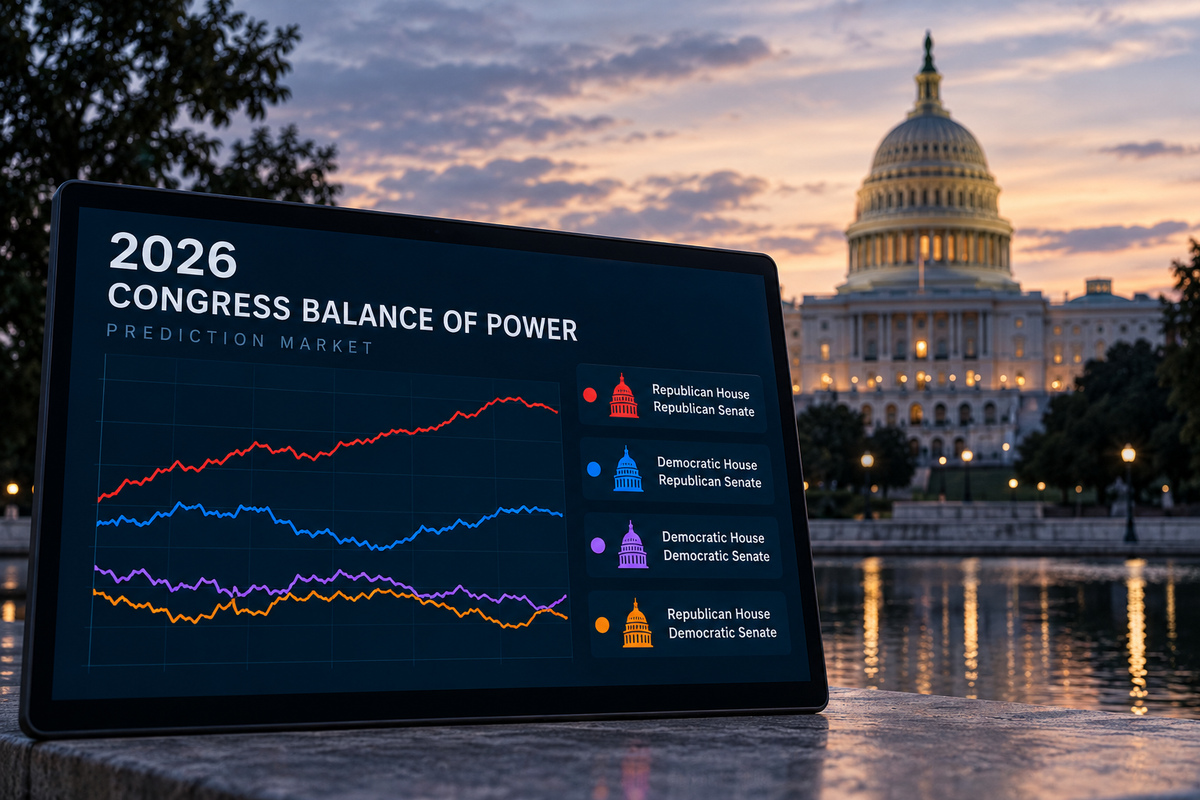
- Democratic House & Senate: 46%
- D - House / R - Senate: 38%
- Republican House & Senate: 15%
- R - House / D - Senate: 1.3%
- Market volume: $10.59M+
- Election Day: Nov. 3, 2026
- As of: Morning of Aug. 27, 2026
Quick Brief
Prediction market traders see Democrats as clear favorites to win control of the House, but the battle for the Senate remains considerably less certain.
According to current probabilities, the most likely balance-of-power outcome is Democratic control of both chambers at 46%. A divided Congress with Democrats controlling the House and Republicans retaining the Senate follows closely at 38%.
Republican control of both chambers is priced at 15%, while the reverse split of a Republican House and Democratic Senate sits at just 1.3%.
The individual chamber markets make the divide even clearer. Traders give Democrats an 85% chance of winning the House, while the Senate is nearly even, with Republicans holding a narrow 51%-49% advantage.
The Big Picture
The different probabilities reflect two very different paths to control of Congress.
Democrats enter the final stretch of the midterms strongly positioned in the House, although taking control is far from guaranteed. The Cook Political Report describes Democrats as the clear favorites while maintaining a narrow path for Republicans to preserve their majority. Its latest ratings also show a substantial group of competitive districts that could ultimately determine control.
The Senate presents a more difficult equation.
Democrats need a net gain of four seats to take control, forcing them to compete across several states that have historically been difficult terrain for the party. Cook currently rates six Senate races as Toss Ups, including five Republican-held seats in Alaska, Iowa, Maine, Ohio, and Texas, along with the Democratic-held open seat in Michigan.
That landscape has become more competitive recently. Iowa and Texas moved from Lean Republican to Toss Up last week, leading Cook to characterize the overall fight for Senate control as a toss-up, although Republicans retain a slight structural advantage.
Reading the Market
The clearest signal is the gap between how traders view the two chambers.
Democrats' 85% probability of winning the House makes a Democratic House the foundation of the two most likely balance-of-power outcomes. Together, those scenarios account for 84% of the combined market.
The Senate is where the uncertainty enters. Republicans lead the standalone market by only two percentage points, leaving both unified Democratic government and a Democratic House paired with a Republican Senate as realistic outcomes.
The longer-term movement is notable, too.
Democrats' House probability has strengthened considerably since last fall, while the Senate market has undergone an even more dramatic shift. What was once a sizable Republican advantage has narrowed toward an essentially even race.
What to Watch
The Senate map should provide the biggest source of movement over the final 68 days.
Iowa and Texas have recently joined an expanding group of competitive races, while Michigan remains an important Democratic-held seat to defend. How those contests develop could determine whether the Senate market stays around 50-50 or begins moving decisively toward either party.
The House remains a different proposition. Democrats are heavily favored by prediction market traders, but dozens of competitive districts still leave room for the overall environment to shift before Election Day.
The relationship between the two chambers will be particularly important for the balance-of-power market. If Democratic House chances remain high, changes in the Senate outlook could increasingly determine whether traders favor unified Democratic control or a divided Congress heading into 2027.
New to prediction markets? Read our complete guide to how prediction markets work.