Will the CLARITY Act Become Law? Prediction Markets Jump Before Key Senate Vote
Prediction markets have sharply raised the chances of crypto market structure legislation becoming law as the CLARITY Act approaches a critical Senate vote.
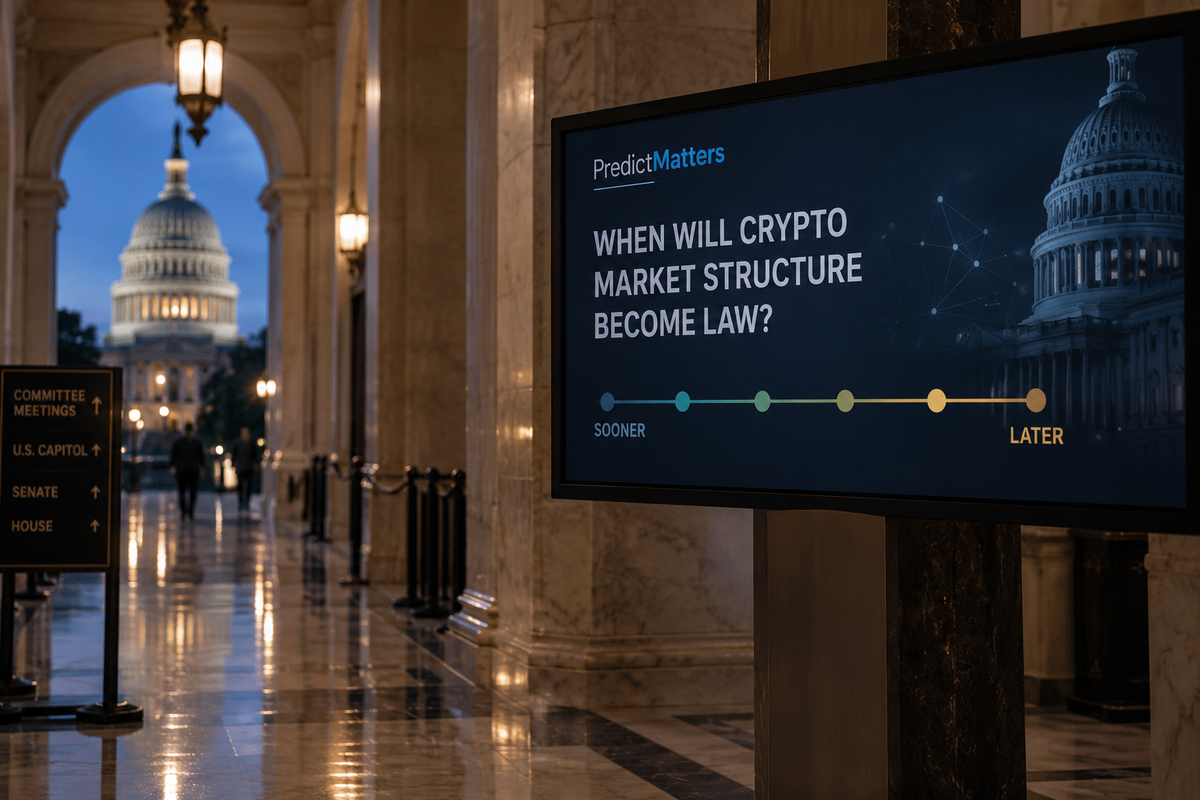
The long-running push for comprehensive U.S. crypto legislation is heading toward one of its biggest tests yet. A revised CLARITY Act has improved the bill’s prospects in prediction markets, but traders still see a longer path to enactment stretching well into 2027.
Market Snapshot
- Before Oct. 1, 2026: 10%
- Before Nov. 1, 2026: 12%
- Before Dec. 1, 2026: 28%
- Before Jan. 1, 2027: 31%
- Before April 1, 2027: 45%
- Before July 1, 2027: 53%
- Volume: $8.64M+
- Next event: Senate procedural vote, Tuesday, Sept. 15, 2:15 p.m. ET
- Prediction market prices as of 11:08 a.m. ET on Sept. 14, 2026.
Quick Brief
The market has become considerably more optimistic about crypto market structure legislation following a new round of negotiations in Washington. On Kalshi, the chance of a qualifying bill becoming law before July 1, 2027 has climbed to 53%, while the April deadline stands at 45%.
The timing tells much of the story. Traders give legislation only a 31% chance of becoming law before the end of 2026, with the probabilities climbing substantially as the deadlines move deeper into 2027.
That leaves Tuesday’s Senate vote as an important test of whether the recent optimism can survive contact with Congress.
The CLARITY Act heads for a critical Senate vote
Senate Republicans released what they described as a final version of the CLARITY Act late Sunday after weeks of negotiations over several sticking points. The revised package incorporates 126 “substantive changes” requested by Democrats, according to its Republican sponsors.
Among the biggest developments is new ethics language aimed at addressing concerns about elected officials’ financial interests in crypto. President Donald Trump agreed to key parts of a bipartisan proposal negotiated by Republican Sen. Thom Tillis and Democratic Sen. Ruben Gallego, including a role for state attorneys general in enforcing its restrictions.
The legislation also includes changes covering DeFi protocols, stablecoin rewards, and other areas that have complicated negotiations. Earlier revisions clarified that certain DeFi provisions apply to spot and cash digital commodity transactions, while the latest package includes additional provisions addressing stablecoin rewards.
Those concessions have created a more favorable backdrop heading into Tuesday, but they have not removed the bill’s immediate mathematical problem.
Sixty votes are the first hurdle
The Senate is scheduled to vote Tuesday on cloture for the motion to proceed to the CLARITY Act. Sixty votes are required to advance the legislation. Republicans hold 53 Senate seats, meaning Democratic or independent support will be necessary even if every Republican backs the motion.
Clearing that hurdle would be significant, but it would not make the CLARITY Act law.
A successful cloture vote would move the Senate into the next stage of considering the legislation. Debate, amendments, and final Senate passage would still remain, and changes made by the Senate would then have to be addressed by the House.
The distinction helps explain the shape of the prediction market.
The chances rise from 31% before 2027 to 45% before April and 53% before July. Rather than pricing Tuesday as the finish line, traders appear to be leaving considerable room for negotiations and congressional procedure to extend beyond this year.
What to Watch
- The 60-vote threshold: Tuesday’s procedural vote is the first immediate test of whether the revised package has attracted enough support to move forward.
- Democratic support: The latest concessions were designed partly to address Democratic concerns, making any public commitments ahead of the vote particularly important.
- The 2026 deadlines: Even a successful Senate vote leaves several legislative steps ahead, helping explain why the market remains below one-in-three for enactment before Jan. 1.
- The 2027 curve: The sharp increase in probabilities from early deadlines into the second quarter of 2027 suggests traders see a meaningful distinction between whether market structure eventually becomes law and whether Congress can finish the job quickly.
Tuesday should provide the clearest indication yet of whether the CLARITY Act’s latest surge reflects a genuine path through Congress or just another temporary burst of optimism in a legislative fight that has already lasted years.
New to event trading? Our guide to prediction markets explains how these markets work, how prices are set, and what to know before getting started.