September Fed Rate Decision Is Now a Coin Flip in Prediction Markets
The Federal Reserve is eight days from its September rate decision, and prediction market traders are almost evenly divided over whether policymakers will raise rates or stand pat.
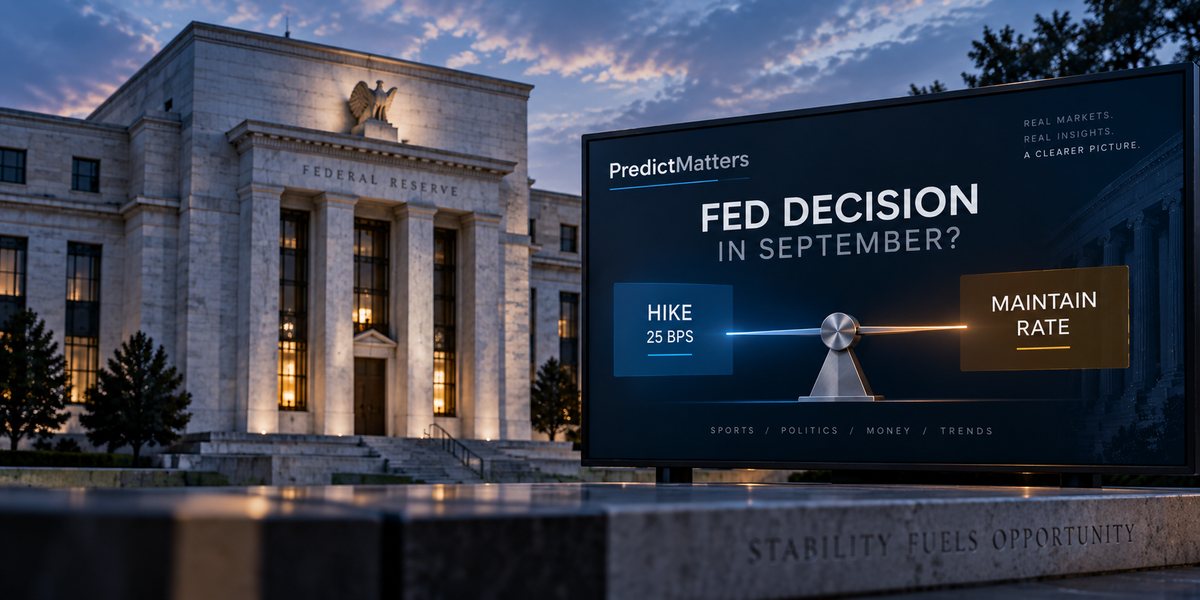
A 25-basis-point hike carries a 52% probability, compared with 48% for another hold. After weeks of shifting expectations, the remaining inflation data may decide which side breaks away.
Market Snapshot
- Hike 25 bps: 52%
- Maintain rate: 48%
- Cut 25 bps: <1%
- Cut >25 bps: <1%
- Hike >25 bps: <1%
- Volume: $40.57M+
- FOMC meeting: Sept. 15–16, 2026
- Current target range: 3.50%–3.75%
- Prediction market prices and volume as of 7:57 a.m. ET on Sept. 8, 2026.
Quick Brief
When we checked this market last week, traders gave a 25-basis-point hike a 53% probability, compared with 46% for the Fed maintaining its current rate.
The topline prices don't look dramatically different today. The path between them has been.
Fed officials have offered competing reasons to move or wait. The August jobs report came in much stronger than expected, and markets are now waiting on the final major inflation reports before next week's decision.
The result is a market with almost no separation left: 52% for a quarter-point hike and 48% for a hold.
Almost everything else has disappeared from consideration. Cuts and a hike larger than 25 basis points are each priced below 1%, making the September decision effectively a two-way question.
Does the Fed tighten again, or give inflation more time to cool?
Strong Jobs Data Strengthened the Case for a Hike
The most consequential new information arrived Friday.
U.S. employers added 162,000 jobs in August, the strongest gain in five months and well above economists' expectations. The unemployment rate held at 4.1%, while labor-force participation increased.
Labor-market weakness had been one argument for patience.
A resilient jobs picture gives the Fed more room to focus on inflation, which remains above its 2% target. Several Wall Street firms adjusted their rate forecasts after the report, including UBS, which shifted from expecting no 2026 policy changes to forecasting quarter-point hikes in September and December.
But the employment report wasn't uniformly inflationary. Average hourly earnings increased 3.1% from a year earlier, slightly slower than July, offering little evidence that wages themselves are accelerating price pressures.
Even a strong jobs report hasn't settled the market.
Fed Officials Have Left the Door Open Both Ways
Fed Chair Kevin Warsh made clear at Jackson Hole that inflation remains the central concern.
Warsh said the Fed's 2% inflation objective is a “firm, fixed target” and noted that recent inflation measures remain too high. He also described the economy and labor market as resilient, leaving policymakers room to respond if price pressures don't improve.
Governor Christopher Waller emphasized the importance of the upcoming inflation data.
Waller said he would be inclined to hold rates steady if upcoming inflation data confirm that disinflation is continuing, while emphasizing that considerable uncertainty remains around the outlook.
That split closely resembles the market itself.
Both Warsh and Waller have acknowledged that inflation remains above the Fed's 2% goal. The disagreement is increasingly about whether policymakers already have enough evidence to tighten now, or whether another month of patience is warranted.
Inflation Could Break the Tie
Two major inflation reports still stand between traders and next week's Fed decision.
The August Producer Price Index arrives Thursday, followed by the Consumer Price Index on Friday, Sept. 11. Both are scheduled for 8:30 a.m. ET, giving policymakers some of their final major economic data before the meeting.
July's CPI offered some encouragement. Consumer prices increased 0.1% during the month, while core prices rose 0.2%. Annual headline inflation stood at 3.4%, with core inflation at 2.5%.
But energy prices have climbed again, adding another complication. Brent crude moved above $99 a barrel Tuesday amid escalating tensions in the Middle East, renewing concerns that higher energy costs could keep inflation elevated.
For a market sitting at 52–48, Friday's CPI report has the potential to matter considerably.
What to Watch
- Thursday's producer prices: PPI will provide the first major inflation reading of the week and could move expectations before CPI arrives the following morning.
- Friday's CPI report: This is the clearest remaining potential catalyst. Softer inflation would strengthen the case for holding, while another firm reading could push traders toward a quarter-point hike.
- The 52–48 split: The winner market has narrowed to essentially a coin flip. A meaningful move away from that range would signal that traders think the remaining evidence has changed the balance.
- No appetite for a larger move: Traders price cuts and hikes larger than 25 basis points below 1%. The uncertainty is about whether the Fed acts, not the likely size or direction if it does.
- The Fed's updated projections: The Sept. 15–16 meeting includes a new Summary of Economic Projections, providing an updated view of where policymakers see inflation, growth, unemployment, and rates heading next.
A week ago, the September decision was close. Eight days from the announcement, it has become even harder to separate the two outcomes.
The jobs report strengthened the argument for another hike. Fed officials have left room to wait. Now inflation gets the final major word.
Prediction market traders are almost perfectly divided over what the Fed will do next.
New to prediction markets? Learn how prices and probabilities work in our guide to prediction markets.