Sports Prediction Markets: How They Work and What to Know
Learn how sports prediction markets work, what you can trade, what moves prices, and what to know before trading.

Sports have become one of the most active areas of prediction markets. Tradeable contracts cover everything from individual games to season-long outcomes. While there are similarities with traditional sports betting, the way prediction markets work can take some getting used to.
Instead of placing a bet at odds set by a sportsbook, you trade contracts tied to specific outcomes. Prices can change as participants buy and sell, allowing you to follow how the market’s expectations evolve before and during an event.
This guide explains how sports prediction markets work, what you can trade, what moves prices, how they differ from sportsbooks, and what to understand before getting started.
Key Takeaways
- Sports prediction markets: Let you trade on event outcomes, including games, championships, season-long results, and other sports-related events.
- Contract prices: Reflect the market’s implied probability of an outcome and can change as new information emerges and participants trade.
- Differences: Prediction markets and sportsbooks may cover similar events, but they operate differently, including how prices are set and how positions can be traded.
- Timing and liquidity: Can have a significant impact on the trading experience, particularly as an event approaches or moves into live trading.
- Rules, costs, and availability: Understanding exactly what you’re trading and how the market resolves is an important part of participating.
What Are Sports Prediction Markets?
Sports prediction markets allow participants to trade contracts based on the outcome of a sporting event. Each contract is tied to a specific question, such as whether a team will win a game or a golfer will win a tournament.
Contract prices generally range from $0 to $1 and can be read as the market’s implied probability of an outcome. For example, if a contract asking whether a team will win a championship is trading at $0.60, the market is assigning that outcome an implied probability of roughly 60%.
If the contract resolves Yes, it settles at $1. If it resolves No, it settles at $0. A trader who bought the contract at $0.60 would therefore earn $0.40 per contract if the predicted outcome occurs, before any applicable fees. Traders can also sell their positions before settlement rather than holding them until the outcome is decided.
That basic structure applies across many types of sports markets. For a deeper explanation of contract pricing, trading, and settlement, see our complete Prediction Markets Explained guide.
What Can You Trade on Sports Prediction Markets?
Sports prediction markets can cover individual events, entire seasons, and many of the outcomes that happen in between. The exact selection varies by platform and sport, but most contracts fall into a few broad categories:
- Game and match outcomes: Contracts tied to individual contests, such as whether a team will win an NFL game, who will win a tennis match, or whether a soccer match will end in a draw.
- Tournament and championship outcomes: Markets covering which team or competitor will win events such as the Super Bowl, a golf major, or another tournament or championship.
- Season-long and futures markets: Longer-term contracts covering outcomes such as whether a team will make the playoffs, how many games it will win, or which player will win an end-of-season award.
- Player, team, and event-specific outcomes: More targeted contracts tied to measurable outcomes within a sport or event, such as a player reaching a statistical benchmark.
The range of available contracts can differ considerably between providers and change throughout a season. It’s important to focus on the specific outcome being measured rather than assume that similarly named markets work the same way.
The common thread is that each contract turns a defined sports outcome into something participants can buy and sell as expectations change.
How Sports Prediction Market Prices Move
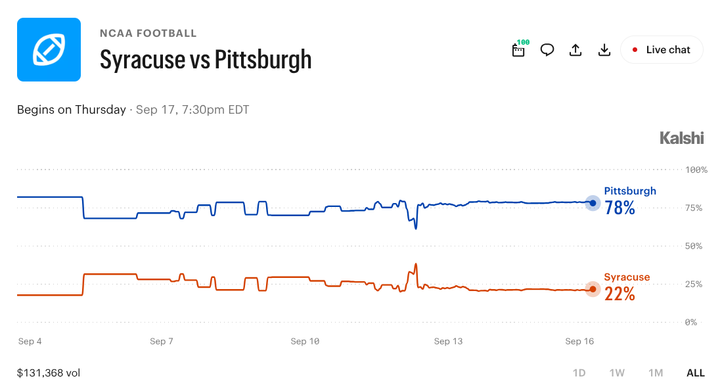
A sports prediction market price is a snapshot of what traders collectively believe at a particular moment. As new information arrives and participants respond by buying and selling contracts, that price can change.
Some catalysts are obvious. An injury to a starting quarterback could reduce the market’s expectations for his team, while confirmation that a previously questionable player will start could move prices in the other direction. Lineup changes, trades, suspensions, and other roster developments can have similar effects.
Conditions surrounding an event can matter as well. Weather may alter expectations for an outdoor game or tournament, while course conditions, venue changes, or other event-specific developments can influence how traders assess the possible outcomes.
Performance also matters. A team that begins a season better than expected may see its playoff probabilities rise. A golfer moving up the leaderboard can quickly become more expensive to back in a tournament market. In markets that remain open during an event, a goal, injury, penalty, or momentum-changing play can produce sharp price movements in seconds.
Not every move has a single identifiable cause. Prices ultimately change because participants are willing to trade at different levels. Several pieces of information may be influencing the market at once. Activity can also be thinner in some contracts, allowing individual trades to have a greater effect on the displayed price.
When interpreting prediction markets, these distinctions matter. A price move tells you that the market’s assessment has changed. It does not necessarily tell you why it changed or guarantee that the new assessment will prove correct.
Timing, Liquidity, and Live Trading
Sports prediction markets can behave differently depending on how far an event is from resolution. A championship market may begin trading months before a season ends, while a game market can remain active until shortly before and during the event itself.
Long-range markets give traders more time to react to changing expectations. A team’s championship price may move throughout a season as results accumulate, injuries occur, rosters change, and the path to the postseason becomes clearer. As an individual game or event approaches, new information can arrive more quickly, and trading activity may increase.
Liquidity also varies considerably. High-profile games and major championships may attract substantial trading, while less popular events or more specific contracts can have fewer participants. In thinner markets, the gap between available buy and sell prices may be wider, and individual trades can have a greater effect on the market.
Some sports contracts also allow live trading after an event begins. Prices can then react in real time as the game or competition unfolds. A team that traded at a 60% implied probability before kickoff might move sharply higher after taking an early lead or lower if the game turns against it.
The closer a market gets to resolution, the more quickly prices can respond to developments. Timing and liquidity are key context for understanding both the price you see and the trading opportunities actually available.
Sports Prediction Markets vs. Sportsbooks
Prediction markets and sportsbooks can offer ways to take a position on many of the same sports outcomes, but the underlying models are different.
The pricing difference is particularly important. A sportsbook is the counterparty accepting a wager at the odds it offers. In a prediction market, participants buy and sell contracts, with trading activity helping determine the prices available in the market.
Prediction markets can also make it easier to treat a sports position as something that can be traded rather than simply held until the event ends. If the market moves after you enter, you may be able to sell before resolution for a gain or loss, provided there is sufficient liquidity.
Neither structure is inherently better. They offer different ways to participate in sports outcomes, with different pricing, costs, rules, and regulatory considerations.
How Sports Prediction Markets Resolve
Every sports prediction market ultimately needs a clearly defined answer. While determining the winner of a completed game may seem straightforward, unusual circumstances can make resolution more complicated.
Resolution rules can become especially important when an event involves:
- Postponements or cancellations: A contract may specify what happens if an event is rescheduled, delayed beyond a certain date, or never completed.
- Overtime or extra periods: Markets can differ in whether overtime, extra innings, penalty shootouts, or similar extensions are included in the result.
- Abandoned or shortened events: Weather or other circumstances can end an event early, making the contract's definition of an official result particularly important.
- Stat corrections: Markets tied to individual or team statistics may depend on the final numbers published by a designated source.
- Disqualifications or unusual outcomes: A later ruling or other change to the official result can affect how a contract settles.
The contract should also identify the league, governing body, statistical provider, or other source used to determine the result. For longer-term markets, the wording can be equally important. A contract must clearly define what qualifies as the winning outcome.
Prediction market platforms publish resolution criteria that establish how each contract will be settled. Those rules are part of the contract itself, not a technicality to consider only when something unusual happens.
Before trading a sports market, understand exactly what outcome the contract measures and what source or rule determines its resolution.
Where Can You Trade Sports Prediction Markets?
Sports contracts are available through several types of prediction market providers, including dedicated exchanges and platforms that offer event contracts alongside other financial or trading products. The sports and markets available can differ considerably between providers, as can fees, trading features, and eligibility requirements.
Availability can also depend on where you live and the regulatory framework under which a provider operates. A platform offering sports contracts in one location may not offer the same products everywhere.
For a broader look at the major providers, their differences, and what to consider when choosing one, see our guide to the Best Prediction Market Platforms.
What to Know Before Trading Sports Prediction Markets
Sports knowledge can help you evaluate an outcome, but understanding the contract and the market around it is just as important. Before trading, consider:
- Know exactly what the contract measures. Similar-looking markets can have different terms, so check the wording and resolution criteria rather than relying on the market title alone.
- Consider timing and liquidity. A major event close to game time may attract substantial activity, while a distant futures market or less popular event could trade more thinly. The displayed price does not necessarily mean you can buy or sell a large position at exactly that level.
- Understand what could move the market. Injuries, lineup announcements, weather, trades, performance, and developments during an event can change expectations and prices quickly.
- Check the resolution rules. Know what result counts, which source determines it, and how unusual circumstances such as postponements or shortened events are handled.
- Understand the costs and platform rules. Fees, spreads, trading mechanics, eligibility, and market availability can differ between providers.
Sports prediction markets turn familiar sporting outcomes into tradable contracts. Understanding both sides of that equation, the sport and the market, is essential to interpreting what the prices are telling you.
Sports Prediction Markets FAQ
How do sports prediction markets work?
Sports prediction markets allow participants to buy and sell contracts tied to specific sports outcomes. Contract prices reflect the market’s implied probability of an outcome and generally settle at $1 if the specified outcome occurs and $0 if it does not.
Are sports prediction markets the same as sports betting?
No. They can cover many of the same events, but the structures are different. Sportsbooks accept wagers at odds they offer, while prediction markets allow participants to trade contracts whose prices are shaped by market activity.
What sports can you trade on prediction markets?
Available sports vary by platform and market. Contracts can cover major professional and college sports, international competitions, individual sports such as golf and tennis, and other sporting events. Market selection can change over time.
Can you trade sports prediction markets during games?
Some sports contracts support live trading while an event is underway. Prices can change rapidly as the game or competition develops. Live trading availability depends on the particular platform and contract.
Why do sports prediction market prices change?
Prices can move as participants react to new information and buy or sell contracts. Injuries, lineup changes, performance, weather, trades, and live developments are among the factors that can influence how the market assesses an outcome.
Are sports prediction markets legal in the US?
Yes, sports prediction markets are legally available to many US users, but availability depends on the platform, contract, and jurisdiction. Federally regulated prediction market exchanges operate under the oversight of the Commodity Futures Trading Commission (CFTC), rather than the state-by-state regulatory system used for traditional sportsbooks. However, sports event contracts remain the subject of regulatory and legal disputes in some states, and access can vary by location and platform. Always check current eligibility and availability where you live.
Where can you trade sports prediction markets?
Sports contracts are available through a growing range of prediction market providers. The markets offered, trading features, costs, and geographic availability differ, so compare platforms before choosing where to trade.