What Will Congress Look Like After the 2026 Midterms? Prediction Market Forecasts
Control of Congress is on the line, but the bigger story may be how many seats each party wins. Kalshi's latest forecasts reveal what's at stake in the House and Senate.

The 2026 midterm elections are here, with control of Congress at stake and prediction markets pointing toward a significant shift in Washington.
Control is only part of the story. Kalshi's seat-count markets offer a closer look at how many seats each party could hold in the next Congress, revealing the potential scale of Democratic gains and Republican losses.
With all 435 House seats and 35 Senate seats on the ballot Tuesday, here's what the latest forecasts show and which races could determine the final numbers.
Market Snapshot: 2026 Midterm Election Odds
- Control of Congress: Democrats sweep both chambers (74%); Democrats win the House and Republicans retain the Senate (21%); Republicans sweep (5.6%); Republicans win the House and Democrats take the Senate (0.6%). Trading volume: $99.5 million.
- Senate control: Democrats 75%, Republicans 25%. Trading volume: $153.7 million.
- House control: Democrats 94.2%, Republicans 5.8%. Trading volume: $219.3 million.
Market prices observed November 2, 2026, at 2:37 p.m. EST. Prices are subject to change.
How Many Senate Seats Will Democrats Win?
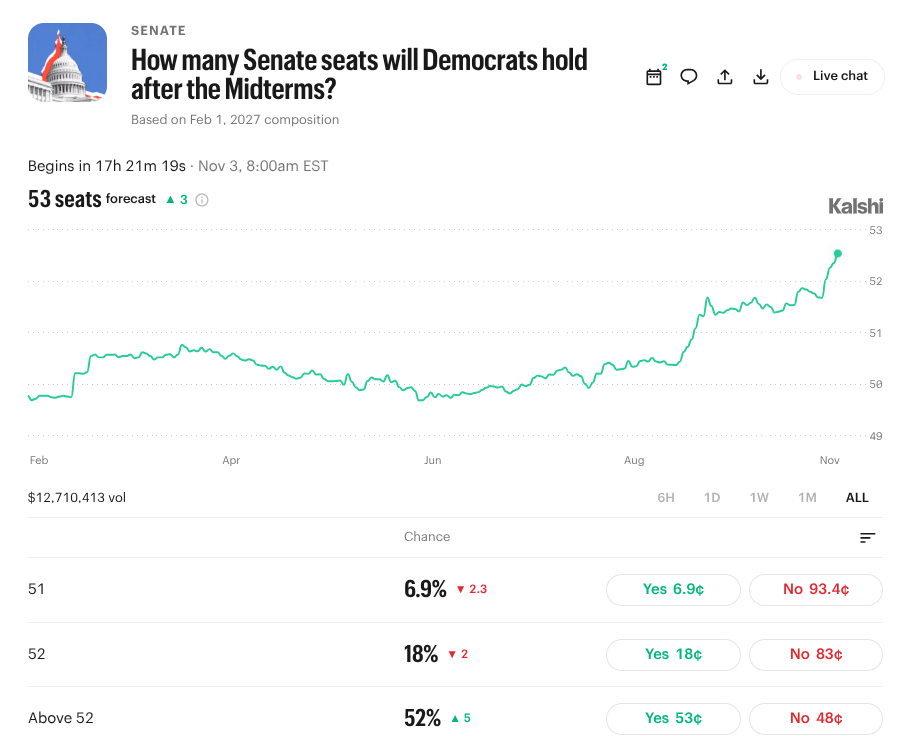
- Kalshi forecast: 53 seats. The Democratic Senate seat-count market projects 53 seats for Democrats, including independents who caucus with the party. The market assigns a 52% probability to Democrats holding more than 52 seats, compared with 18% for exactly 52 and 6.9% for 51.
- The four-seat hurdle: Democrats and the two independents who caucus with them currently hold 47 seats. A net gain of four would give them a 51-seat majority. The market's 53-seat forecast implies a net gain of six.
- Republican-held pickup opportunities: Maine, North Carolina, Ohio, Iowa, Texas, and Alaska are among the states drawing attention in the Senate battleground. The number of Republican-held seats Democrats capture will largely determine whether their gains extend beyond the minimum needed for control.
- Democratic defenses still matter: Michigan, Georgia, and New Hampshire are among the states where Democrats must protect existing seats. A Republican pickup in any of these contests would increase the number of GOP-held seats Democrats need to flip elsewhere.
- A larger majority changes the arithmetic: A 51-seat Democratic Senate would leave little room for defections on closely divided votes. A 53-seat delegation would provide a wider cushion, making the difference between a narrow takeover and a more substantial majority consequential beyond Election Night.
How Many Senate Seats Will Republicans Win?
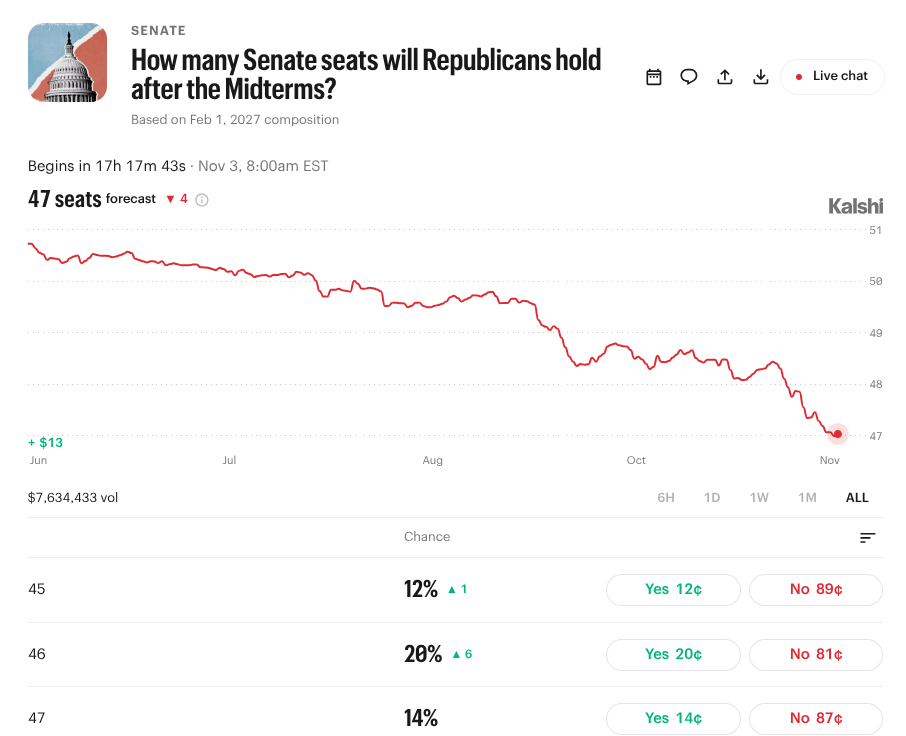
- Kalshi forecast: 47 seats. The Republican Senate seat-count market projects 47 Republican seats, down from the party's current 53. From a trading perspective, 46 seats carries a 20% probability, 47 seats stands at 14%, and 45 seats at 12%.
- Republicans have a smaller margin for losses: With 53 seats entering the election, the GOP can afford a net loss of three and still retain control through the vice president's tie-breaking vote. A fourth net loss would put Democrats at 51 seats.
- Maine and North Carolina are important defensive contests: Both Republican-held seats feature in the fight over the Senate majority. Holding them would reduce the number of additional victories Democrats could accumulate, while losses would add pressure to Republican defenses elsewhere.
- Ohio, Iowa, Texas, and Alaska could determine the scale of losses: These contests matter not only for control but also for the final Republican seat total. Results across several states will determine whether Republicans finish close to 50 seats or fall further into the minority.
- Republican pickup opportunities offer a counterweight: Michigan, Georgia, and New Hampshire provide potential routes to offset losses in GOP-held states. Even one Democratic-held seat changing hands would alter the net-gain calculation and could materially affect the Republican total.
How Many House Seats Will Republicans Win?
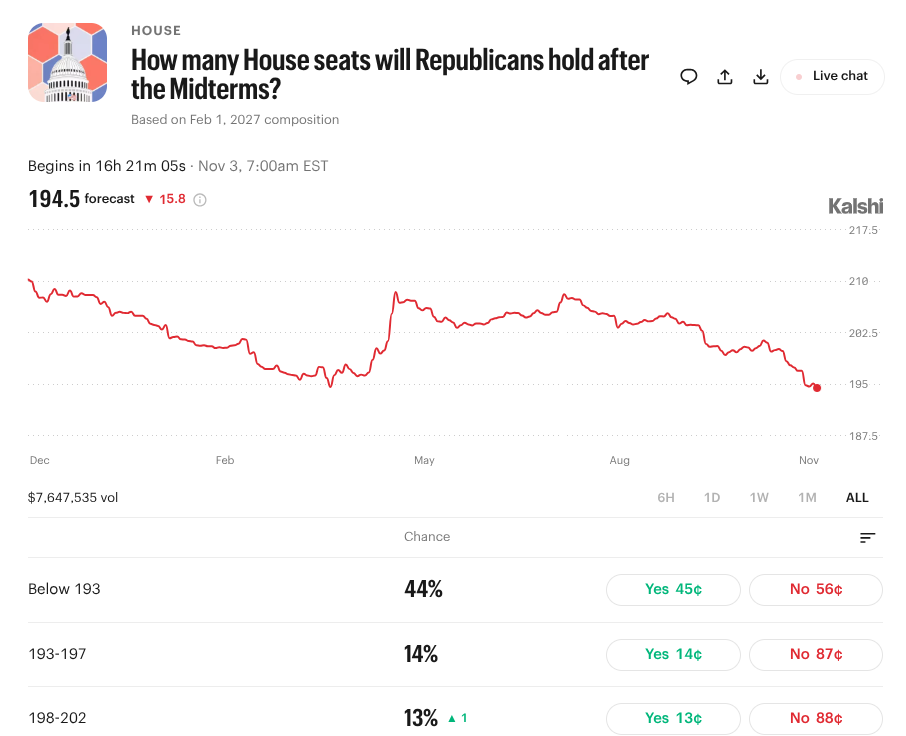
- Kalshi forecast: 194.5 seats. The Republican House seat-count market places the GOP's expected total below 200 seats. The market assigns a 44% probability to fewer than 193 Republican seats, 14% to 193-197, and 13% to 198-202.
- The forecast has moved sharply downward: Kalshi's displayed Republican seat projection has declined 15.8 seats over the charted period, reaching 194.5 on election eve. That puts the market's central estimate well below the 218 seats ordinarily needed for a House majority.
- Republican-held toss-ups are a central vulnerability: Cook Political Report's November 2 ratings place 18 House contests in the toss-up category, including 14 Republican-held districts and four Democratic-held districts. That imbalance helps explain why GOP losses could extend beyond the seats required to change control.
- Pennsylvania, Michigan, and California offer important tests: PA-08, MI-10, and CA-22 are among the competitive districts where Republican incumbents or Republican-held seats face consequential contests. Results in these districts could help determine how far the GOP seat total falls.
- The difference between 190 and 205 seats matters: Both outcomes would leave Republicans short of a majority, but they would produce very different minority delegations. The seat-count market captures that distinction more directly than the House-control contract.
How Many House Seats Will Democrats Win?
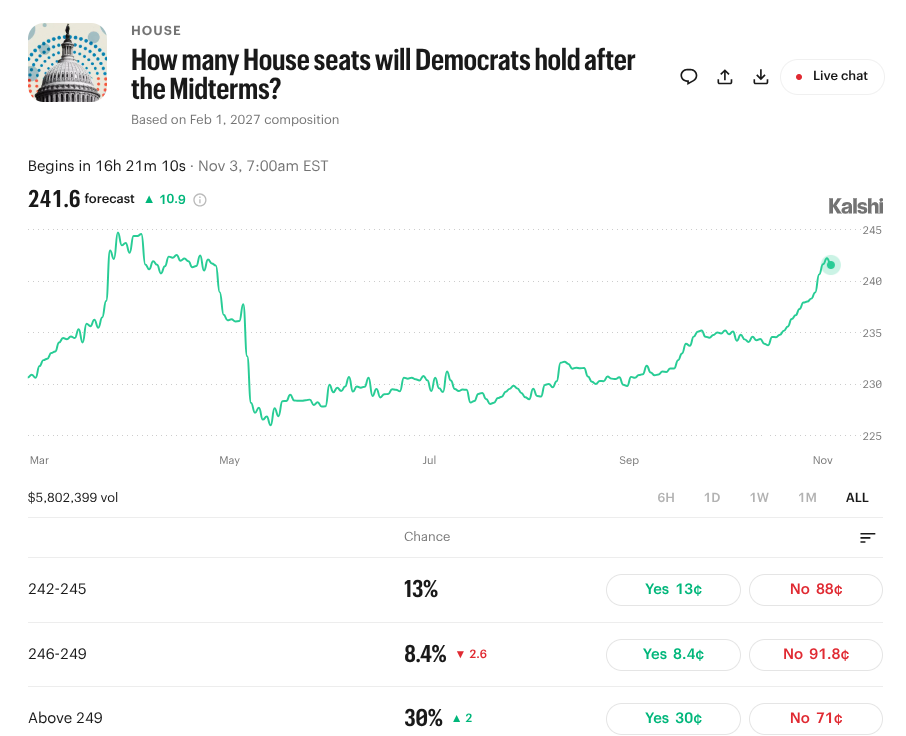
- Kalshi forecast: 241.6 seats. The Democratic House seat-count market projects approximately 242 seats, with a 30% probability assigned to more than 249 seats. The market also prices 242-245 seats at 13% and 246-249 at 8.4%.
- A majority is only the starting point: Democrats need 218 seats for control of the 435-member House. Kalshi's forecast sits nearly 24 seats above that threshold, indicating that the market is pricing a considerably larger delegation than the minimum required.
- The House battleground extends across multiple regions: Competitive districts in Pennsylvania, Michigan, New York, Texas, and California offer different routes to Democratic gains. The final total will depend on how consistently Democrats convert competitive Republican-held districts while defending their own vulnerable seats.
- NY-17 and TX-15 illustrate different competitive environments: New York's 17th District is rated Lean Democratic by Fox News, while Texas's 15th District is rated a toss-up. Their outcomes will contribute to the broader question of whether Democratic gains are concentrated in the closest races or extend across a wider range of districts.
- A larger majority would carry legislative consequences: A Democratic House with roughly 242 seats would have substantially more room to absorb defections than a narrow 218- or 220-seat majority. The final count will help determine the party's flexibility on legislation, committee organization, and oversight during the next Congress.
What to Watch for on Election Night
The first results Tuesday evening will begin answering the question of who controls Congress. The more revealing story may be how far the results depart from the narrow majorities that have defined recent years. Three developments deserve particular attention:
- Control of Congress: Kalshi assigns a 74% probability to Democrats winning both chambers, compared with 21% for a Democratic House and Republican Senate. The split-control outcome remains an important alternative in the market, particularly if Republican Senate candidates outperform expectations in competitive states.
- Senate: North Carolina is a Republican-held seat to monitor, while Alaska, Iowa, Kansas, Maine, Ohio, and Texas are among the seven toss-ups identified by Cook Political Report alongside Democratic-held Michigan. These states will help establish whether Democrats reach the 51-seat threshold or approach Kalshi's 53-seat forecast.
- House: Watch the Republican-held districts rated as toss-ups, including MI-10, NY-17, TX-15, and CA-22. Cook's final ratings place 222 seats in Democratic-leaning categories, 195 in Republican-leaning categories, and 18 toss-ups. Those competitive districts could determine whether Democrats secure a modest or substantial majority.
The battle for control of Congress is the headline for Election Night, but the final seat counts will tell a bigger story. How large those majorities or minorities become will help define the balance of power in Washington for the next two years.