
Blue Wave or Blue Tsunami? What Prediction Markets Say About the 2026 Midterms
With the 2026 midterms just two weeks away, Democrats are eyeing major gains in Congress. But will November deliver a narrow shift in power or a sweeping victory? Two Kalshi prediction markets reveal how traders are sizing up the possibilities.

The November 3 midterm elections are approaching, and prediction markets are pricing the possibility of substantial Democratic gains in Congress.
Two contracts on Kalshi offer different answers. One measures the likelihood of a blue wave, requiring Democrats to reach specified seat totals in both chambers. The other sets a considerably higher bar for a blue tsunami.
2026 Midterms: Prediction Market Snapshot
Sources: Kalshi, U.S. House Clerk, and U.S. Senate. Market prices as of October 20, 2026.
Both markets resolve based on congressional composition on February 1, 2027, with independents who caucus with either party counted toward that party's totals.
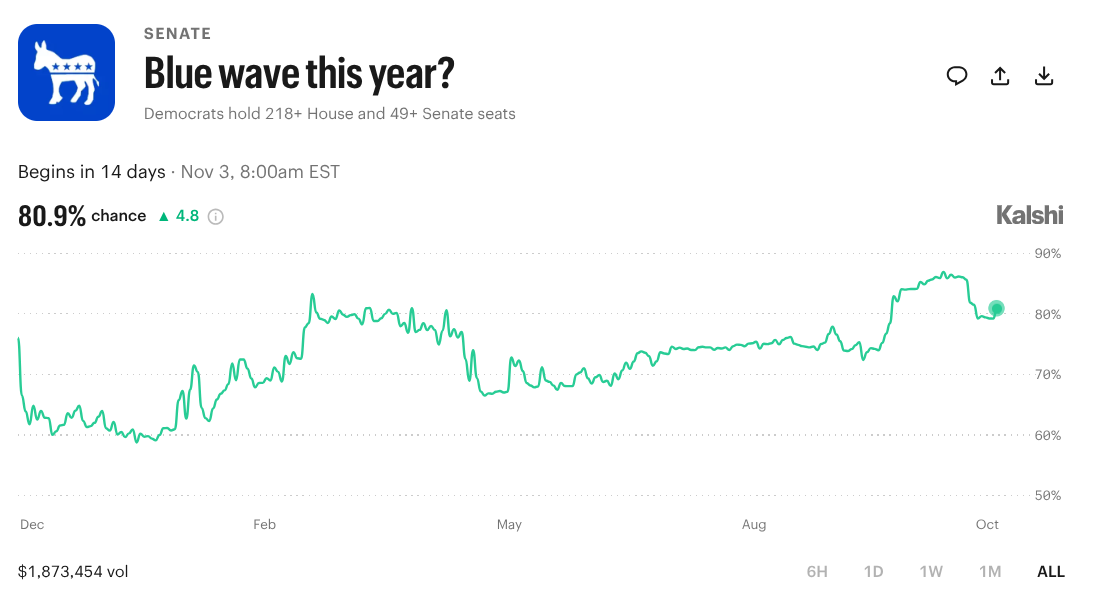
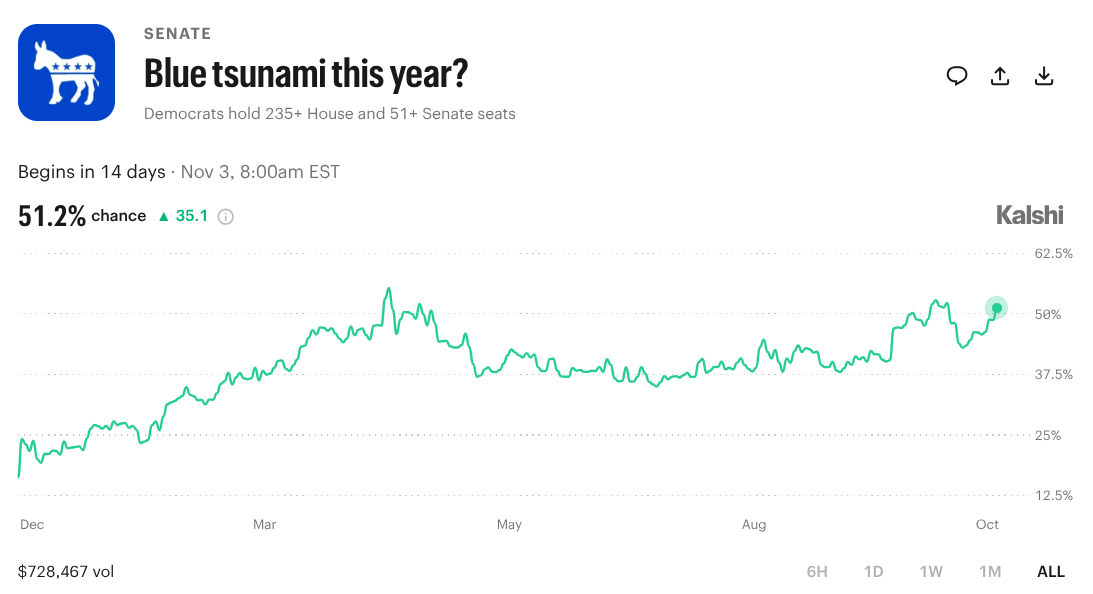
As of October 20, Kalshi prices give Democrats an 80.9% chance of a blue wave, compared with a 51.2% chance of a blue tsunami. Both thresholds must be met. Reaching the required House total without reaching the Senate total, or vice versa, is insufficient.
Blue Wave: What Would It Take?
Kalshi's Blue Wave market requires Democrats to hold at least 218 House seats and 49 Senate seats when the contracts are settled. The requirements represent a relatively narrow path to a Democratic House majority and modest Senate gains.
Three factors help explain why traders consider that combination likely:
- The House battleground is expanding. Democrats need 218 seats to secure a majority, and the electoral map is increasingly offering opportunities beyond the traditional swing districts. On October 16, the Cook Political Report shifted 11 House races toward Democrats, suggesting the party has multiple paths to reclaiming the chamber.
- The Senate hurdle is lower than it sounds. With 47 Democratic-aligned seats today, the party needs a net gain of just two to meet the Blue Wave threshold, not the four needed to reach 51. Republican-held seats in North Carolina and Maine are among the key pickup opportunities, although Democrats must also protect their existing seats.
- The national mood provides a tailwind. An October 19 Reuters/Ipsos poll found Democrats leading Republicans 47%–35% among registered voters on the congressional generic ballot. That 12-point advantage suggests a favorable political environment, although translating national support into congressional seats remains a separate challenge.
The Blue Wave contract last traded at 80¢, after approaching 88¢ earlier in October. Its relatively high price reflects expectations that Democrats can meet both thresholds, not necessarily secure outright control of the Senate.
Blue Tsunami: How Much Bigger Would the Victory Need to Be?
The Blue Tsunami market raises the requirements to 235 House seats and 51 Senate seats. That's 17 additional House seats and two additional Senate seats beyond the Blue Wave thresholds.
Reaching those totals would require a substantially broader Democratic victory.
- A House landslide requires a wider battlefield. Cook's October 9 analysis projected a most likely Democratic outcome of 224–234 seats, just short of the 235-seat tsunami threshold. But the map is expanding: on October 16, Cook moved Montana's 1st District, which Trump carried comfortably in 2024, into the Toss Up category. Democrats would need those broader opportunities to translate into victories.
- The Senate majority is the bigger obstacle. Democrats need a net gain of four seats to reach 51 Democratic-aligned senators, assuming caucus affiliations remain unchanged. That means winning beyond their most promising pickup opportunities while defending their own vulnerable seats. Even a commanding House victory wouldn't satisfy the tsunami contract without those Senate gains.
- The path is plausible, but far from secure. Cook's October 6 analysis estimated potential Democratic Senate gains of two to six seats. That range puts 51 within reach, but also leaves room for Democrats to fall short. Competitive Republican-held seats in Alaska, Iowa, Kansas, Maine, Ohio, and Texas could ultimately determine whether the party clears the higher threshold.
The Blue Tsunami market last traded at 51¢, up from roughly the low 20s in late 2025. Traders now price the larger outcome near a coin flip, even though its House and Senate requirements are considerably more demanding.
What to Watch Before the November 3 Midterms
With Election Day two weeks away, several developments could influence whether traders become more confident in a Democratic wave or begin pricing an even larger victory.
- Senate races could decide the size of the wave. Watch whether late polling shows Democrats gaining ground in Republican-held states beyond their strongest pickup opportunities. Those additional victories could make the difference between satisfying the wave and tsunami contracts.
- The House map could widen or tighten. Late shifts in Republican-leaning districts will help reveal whether Democratic momentum extends beyond the traditional battlegrounds. A broader competitive map would strengthen the case for 235 seats, while signs of Republican stabilization could limit expectations.
- The closing stretch will test Democratic momentum. Final state-level polls, campaign spending shifts, and early-voting data could provide fresh signals about the electoral landscape. But early turnout figures don't reliably establish which party is ahead, making the final results far from certain.
The gap between Kalshi's two markets captures the central uncertainty heading into November 3: Democrats are favored to achieve the more modest combination of gains, but the prospect of a much larger congressional victory remains considerably less certain.