Will Tesla and SpaceX Merge? Prediction Market Prices & Timeline
Kalshi traders see a 72% chance of a Tesla–SpaceX merger announcement before 2028, as Wall Street weighs the strategic appeal, financial hurdles, and possible timing of a deal.

Could Elon Musk combine Tesla and SpaceX into a single company?
The possibility has gained attention following Tesla's recent Roadster demonstration, which showcased SpaceX technology, and fresh Wall Street analysis exploring a potential merger.
No definitive agreement has been announced, but Kalshi's prediction market offers a window into whether traders expect a deal and when it might happen.
Tesla–SpaceX Merger Market Snapshot
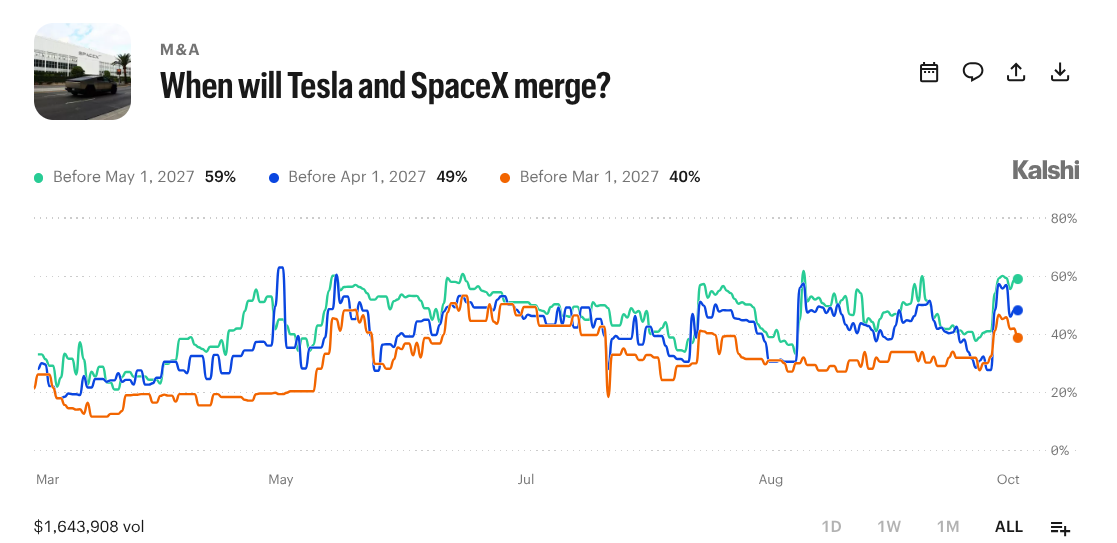
Kalshi market prices as of 11:16 a.m. ET on October 19, 2026.
Contracts resolve Yes if Tesla or SpaceX officially announces a definitive, binding agreement to merge, acquire one another, or combine under common corporate ownership before the specified deadline. The transaction does not need to close by that date. Rumors, preliminary negotiations, and expressions of interest do not qualify.
Tesla–SpaceX Merger Prices & Timeline
The most interesting tension is between Wall Street's near-term speculation and the market's more cautious outlook. Barclays has floated the possibility of a merger announcement ahead of Tesla's December 3 shareholder meeting, but traders are assigning relatively little weight to that scenario.
The longer-dated contracts point to greater confidence in an eventual agreement than an imminent announcement. One possible explanation is the complexity of negotiating a transaction involving two companies of this size, from their relative valuations to ownership and shareholder approvals.
Why Would Tesla and SpaceX Merge?
The potential rationale for combining Tesla and SpaceX extends beyond their existing technology partnerships. Analysts see opportunities to integrate AI development, coordinate major investments, and consolidate more of Musk's businesses.
- A more integrated AI business: Tesla brings autonomous vehicles, robotics, and manufacturing capabilities. SpaceX brings satellite infrastructure and the AI operations acquired through xAI. A merger could connect those businesses more directly, potentially supporting Musk's ambitions to deploy AI across physical products and large-scale computing systems.
- Financing enormous ambitions: Tesla and SpaceX face substantial investment requirements, from AI computing and robotics to satellites and launch infrastructure. A combined company could coordinate those spending priorities and potentially access a broader pool of capital. Whether those benefits outweigh the financial risks is an open question.
- Consolidating Musk's corporate empire: SpaceX acquired xAI in February 2026, while Tesla subsequently invested $2 billion in SpaceX shares. Barclays has explored taking that relationship further through an all-stock acquisition of Tesla by SpaceX, bringing more of Musk's businesses under common ownership.
The potential upside is substantial, but combining the companies would also tie Tesla shareholders more directly to SpaceX's capital-intensive operations and the financial risks of Musk's broader AI strategy.
What Could Prevent a Tesla–SpaceX Merger?
Combining Tesla and SpaceX would involve more than agreeing on a shared technological vision. Any proposed transaction would need to overcome substantial financial, operational, and governance challenges.
- The valuation problem: An all-stock merger would require Tesla and SpaceX to agree on an exchange ratio that determines how much of the combined company each shareholder group owns. Even with both companies publicly traded, differing growth expectations and market valuations could make a mutually acceptable deal difficult to structure.
- Different businesses, different risks: Tesla shareholders would gain greater exposure to SpaceX's launch operations, satellite business, and AI investments, while SpaceX investors would become more exposed to Tesla's automotive and robotics businesses. Those combinations could create opportunities, but they would also introduce risks that some shareholders may not want.
- Musk's competing responsibilities: Musk's leadership and financial interests across both companies could create conflicts when negotiating terms. Independent board oversight, shareholder approvals, and potential regulatory scrutiny would add complexity to any proposed combination.
Ultimately, a merger would need to offer more than strategic synergies. The companies would have to demonstrate that the proposed terms create value for both groups of shareholders.
What to Watch in the Tesla–SpaceX Merger Market
SpaceX's October 20 earnings report and Tesla's October 21 results are the next potential catalysts, followed by Tesla's December 3 shareholder meeting. Investors will be watching for comments about AI infrastructure, capital spending, and closer cooperation between the companies.
More consequential would be confirmation of merger negotiations, details of a proposed transaction structure, or an official agreement. Any of those developments could reshape Kalshi's prices as traders reassess the likelihood and timing of a deal.