Brewers vs. Rays: What Prediction Markets Say About the 2026 World Series
Milwaukee enters the Fall Classic as the clear favorite, but Tampa Bay brings formidable pitching and a chance to upset the market's expectations. Here's how the championship and series-length contracts stack up ahead of Game 1.

For the first time in nearly half a century, Major League Baseball will crown a World Series champion that has never won the title before.
The Milwaukee Brewers and Tampa Bay Rays meet in the 2026 World Series beginning Friday, October 23, at 8 p.m. ET at Milwaukee's American Family Field. The Brewers are making their first appearance since 1982, while the Rays are returning for the first time since 2020.
Both teams finished atop their respective leagues during the regular season, but prediction markets see a distinct favorite. Milwaukee's dominant postseason run, powerful bullpen, and home-field advantage have helped establish the Brewers as the team to beat.
The market for how long the series will last suggests a championship matchup with plenty of room for drama.
World Series Prediction Market: Milwaukee Favored Over Tampa Bay
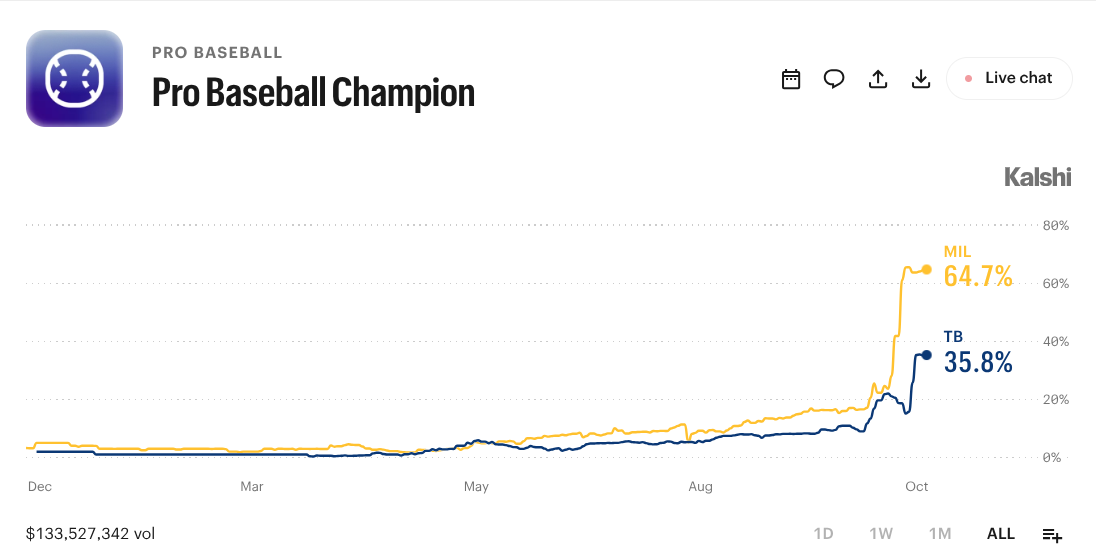
Current pricing gives the Brewers a commanding advantage, but it doesn't make the Rays an afterthought. Tampa Bay still carries roughly a one-in-three implied chance of claiming its first championship.
Milwaukee's position reflects an impressive body of work. The Brewers won an MLB-best 103 regular-season games and are 7–1 in October, including a four-game sweep of the defending champion Los Angeles Dodgers.
Tampa Bay, however, won 98 regular-season games and has lost only twice in nine postseason contests. This is a matchup between two of baseball's strongest teams, even if the market doesn't consider them equals.
Brewers vs. Rays: World Series Matchup Preview
Postseason statistics through the League Championship Series, except regular-season records. Runs scored and allowed are per-game averages.
Postseason statistics through the League Championship Series. Runs scored and allowed are per-game averages.
The Brewers and Rays earned first-round byes before taking different paths to the World Series. Milwaukee needed just eight games to win the National League pennant, while Tampa Bay recovered from a 2–1 deficit against Cleveland to win the American League Championship Series in six.
Milwaukee has generated more offense during the postseason, with a substantial advantage in OPS and a higher scoring average. NLCS MVP Jake Bauers exemplified that production, driving in six runs during the Dodgers sweep, including a go-ahead two-run homer in Game 3 and a pivotal two-run double in the clincher.
The Brewers' bullpen has allowed just six earned runs in 40⅔ postseason innings. Aaron Ashby, Trevor Megill, and the rest of Milwaukee's relief corps have helped compensate for a rotation that hasn't consistently worked deep into games.
Tampa Bay's pitching presents a different challenge. ALCS MVP Freddy Peralta posted a 0.75 ERA across 12 innings against Cleveland, winning both of his starts and contributing a relief appearance. The former Brewer now faces the organization where he spent the first eight seasons of his major league career.
The Rays also have Drew Rasmussen, who has posted a 1.29 postseason ERA across 21 innings, and closer Bryan Baker, who has yet to allow a run in seven October innings.
Milwaukee will host Games 1 and 2, with the series shifting to Tampa Bay for the next three contests, if necessary. The Brewers would also host Games 6 and 7 if the matchup goes that far.
How Many Games Will the World Series Last?
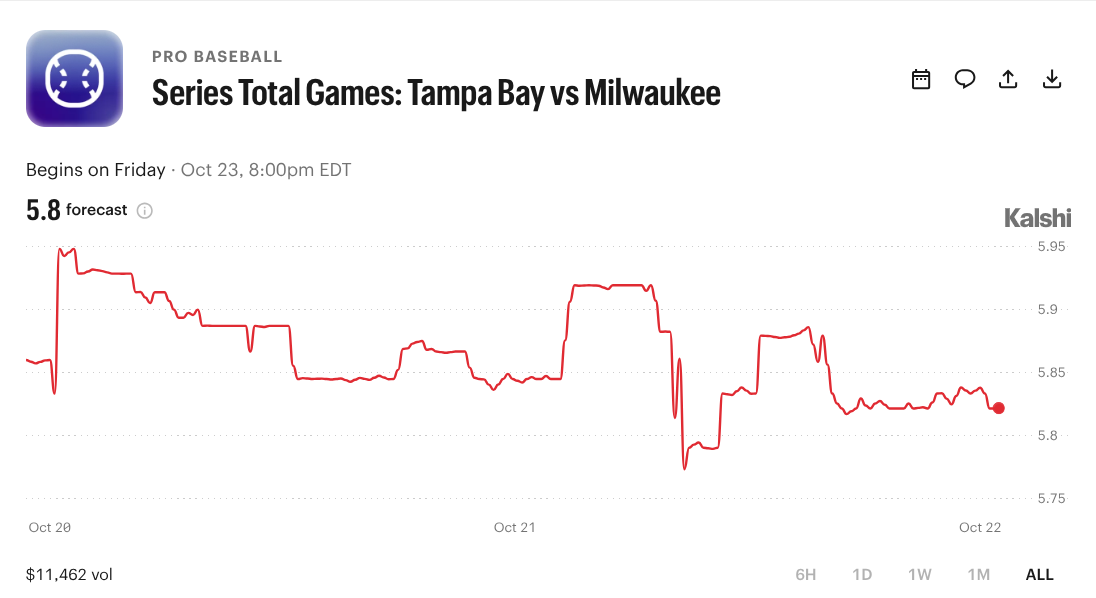
Kalshi's series-length market suggests traders expect a competitive series that lasts a while, even with the Brewers holding a sizable advantage in the championship market.
A six- or seven-game series is favored over a shorter finish. Said another way, Tampa Bay is expected to win at least two games more often than not. A sweep remains possible, but it's far from the prevailing expectation.
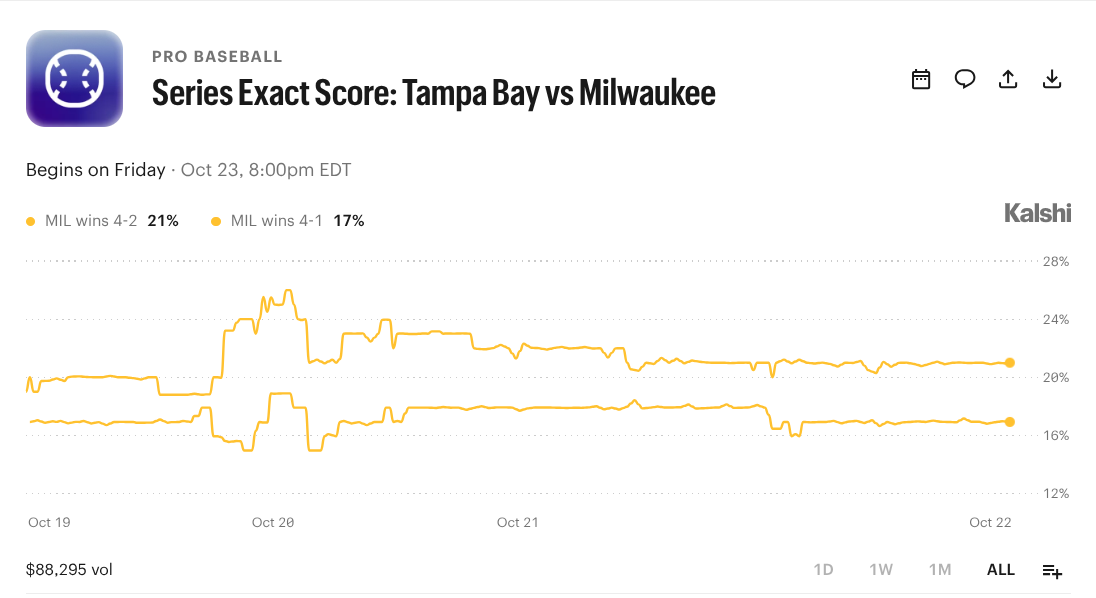
The exact-score market reinforces that outlook. Milwaukee winning 4–2 is the leading individual outcome, although no single result commands a particularly large share of the probability.
Taken together, the markets favor a Brewers championship without suggesting an easy path to the title. Tampa Bay may be the underdog, but traders still see considerable room for a competitive series.
World Series MVP Prediction Market: Who's Favored?
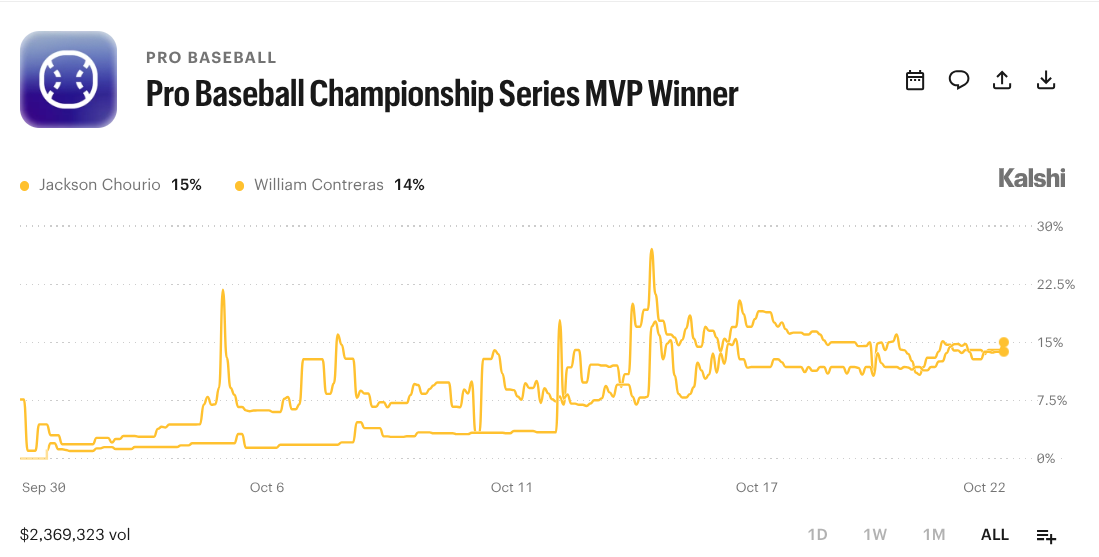
Milwaukee is the clear favorite to win the World Series, but the MVP prediction market presents a much more competitive picture. No individual player commands even a 20% implied probability, suggesting considerable uncertainty over who might snag the award.
Jackson Chourio and William Contreras lead the Milwaukee contenders. Chourio hit .291 with 25 home runs during the regular season and leads the Brewers with seven postseason RBIs, despite batting just .171 in October. Contreras has been far more consistent in the playoffs, hitting .367 with three home runs and a 1.157 OPS.
For Tampa Bay, Junior Caminero and Yandy Diaz offer contrasting paths to the award. Caminero brings the power, including a pivotal two-run homer in the ALCS clincher against Cleveland. Diaz has provided steadier production, batting .308 with two home runs and hits in eight of the Rays' nine postseason games.
The market's uncertainty is understandable. Even with Milwaukee favored to win the championship, a dominant pitching performance or a few decisive swings could quickly elevate a player who currently sits well down the MVP board.
What Could Decide the 2026 World Series?
The championship market favors Milwaukee, but the matchup contains several factors that could either reinforce that position or create an opening for Tampa Bay.
- Can Milwaukee's starters work deeper into games? Jacob Misiorowski is expected to start Game 1 against Rasmussen. The Brewers' arm has pitched only 8⅓ innings across two postseason starts, neither lasting beyond the fifth. Rasmussen has completed 21 innings in three starts. If Tampa Bay can drive up Milwaukee's pitch counts, it could complicate their pitching plans as the series progresses.
- Will the Brewers' bullpen continue its dominance? Milwaukee's 1.33 postseason relief ERA is a major advantage, with Ashby delivering 12⅓ scoreless innings and Megill anchoring the late innings. Tampa Bay has its own reliable closer in Baker, but the Brewers have demonstrated exceptional depth. The question is whether that edge holds up over a potentially seven-game series.
- Can Tampa Bay's lineup close the offensive gap? The Rays have posted a .650 postseason OPS compared with Milwaukee's .739. Junior Caminero, Yandy Díaz, and Jonathan Aranda give Tampa Bay dangerous hitters, but the Rays will need contributions throughout the lineup against a pitching staff that has limited opponents to just 2.63 runs per game.
- How much will home-field advantage matter? Milwaukee earned the right to host a potential seventh game by finishing with baseball's best regular-season record. With the series opening in Wisconsin, Tampa Bay faces an immediate challenge: taking at least one game on the road before returning home, where it won 55 of 81 regular-season contests.
Milwaukee enters the World Series with the stronger market position, a dominant bullpen, and an offense that has outperformed Tampa Bay's during October. The Rays have the starting pitching, defensive strengths, and postseason resilience to make the series competitive.
While the winner market favors the Brewers, the series-length markets suggest a challenging path to a championship.