2026 Midterm Prediction Market Odds: Who Will Control Congress?
With Election Day one week away, Kalshi traders are pricing a change in congressional power. Markets reveal a much clearer consensus on the House than on the Senate.
One week remains before the November 3 midterm elections, and prediction markets are pointing toward a possible reshaping of Congress.
Republicans enter Election Day controlling both chambers. The latest Kalshi prices show Democrats with a substantial advantage in the market for House control and a narrower one in the Senate.
Winning the House requires Democrats to overturn a slim Republican majority across hundreds of districts. Taking the Senate requires a net gain of four seats, with competitive contests spread across states that have very different political histories.
Here's how traders are pricing congressional control and the races that could determine whether those expectations hold.
Market Snapshot
- Midterms: Congress Balance of Power? Democrats Sweep (63%), D-House, R-Senate (29%)
- Which party will win the US Senate? Democratic Party (64%), Republican Party (36%)
- Which party will win the US House? Democratic Party (90.8%), Republican Party (9.8%)
Who Will Control Congress After the 2026 Midterms?
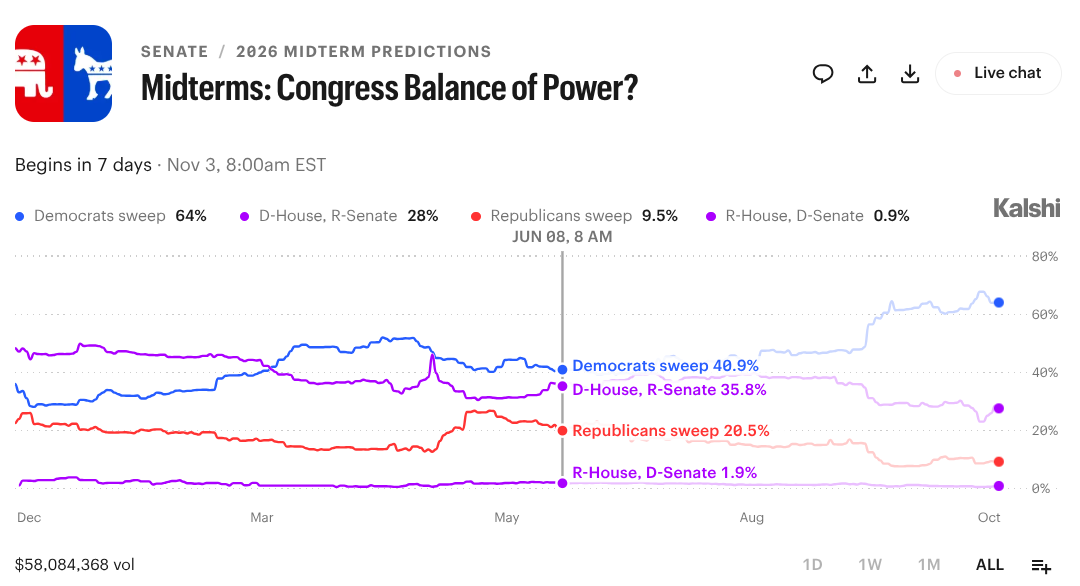
Kalshi's Congress balance-of-power market paints a dramatically different picture from the Republican-controlled Congress that entered 2026.
A Democratic sweep of both chambers leads the market at 64%, more than double the 28% price for Democrats taking the House while Republicans retain the Senate. A Republican sweep stands at just 9.5%, while the reverse split of Republicans holding the House and Democrats taking the Senate is priced at 0.9%.
The imbalance is revealing. Of the four possible configurations, the two carrying the highest prices both involve Democrats controlling the House. The real divide in the market is over which party emerges with the Senate.
Two underlying markets help explain the imbalance:
- House: Democrats are priced at 90.4% to control the chamber, compared with 9.6% for Republicans. With a narrow Republican majority at stake, relatively modest changes across competitive districts could alter control.
- Senate: Democrats are priced at 65%, compared with 35% for Republicans. The GOP enters the election with a 53-47 majority, including two independents who caucus with Democrats. A 50-50 split would leave Republicans in control through the vice president's tiebreaking vote.
The question now is whether Democrats can convert their opportunities in competitive Senate races into the four-seat gain needed for a majority. The House market reflects a much clearer expectation, but the Senate battlefield leaves considerably more room for the final week of campaigning and Election Day itself to change the balance of power.
Who Will Control the Senate in 2026?
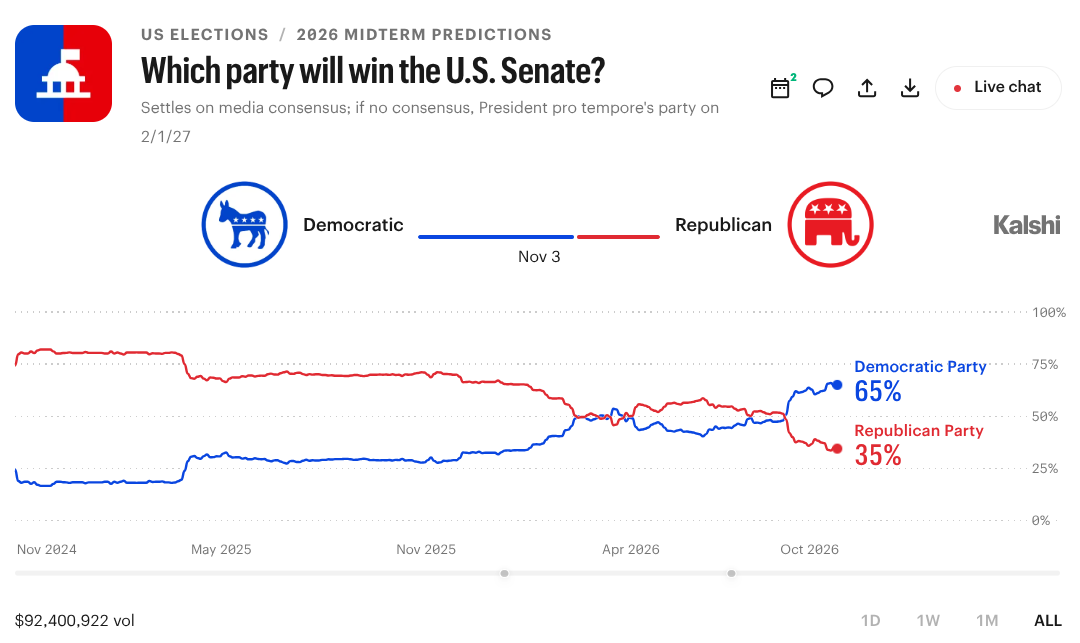
The battle for the Senate is considerably tighter. Kalshi's Senate control market puts Democrats at 65%, compared with 35% for Republicans, reflecting a competitive electoral map with several consequential races still in play.
Democrats need a net gain of four seats to take control, leaving little room for setbacks. Republican-held seats in Texas, Maine, Ohio, and Iowa present potential pickup opportunities, but the party must also defend Michigan. A loss there would require Democrats to flip five Republican-held seats rather than four.
Five races illustrate the arithmetic:
- Texas: Republican Ken Paxton and Democrat James Talarico are competing for an open GOP-held seat. Texas has become a major focus of Senate spending, while recent surveys show a competitive contest. An October 20-21 Rasmussen poll measured the candidates at 45% each. A Democratic victory here would represent a significant pickup in a state Republicans have relied upon for decades.
- Maine: Republican Sen. Susan Collins faces Democrat Troy Jackson. A Fox News poll published October 22 measured the race at 49% apiece. Maine offers Democrats a potential pickup, but Collins's long tenure and history of winning difficult elections make the contest distinct from the open-seat battles elsewhere.
- Michigan: Democrat Abdul El-Sayed faces Republican Mike Rogers for a Democratic-held open seat. A Marist poll conducted October 15-18 measured El-Sayed at 50% and Rogers at 48%. Michigan is a defensive priority for Democrats. Losing the seat would complicate an already demanding path to a Senate majority.
- Ohio: Former Democratic Sen. Sherrod Brown is seeking a return to Washington against Republican Sen. Jon Husted in a special election. The contest has attracted enormous advertising investment. Cook Political Report's October battleground poll measured Brown at 49% and Husted at 43%.
- Iowa: Democrat Josh Turek and Republican Ashley Hinson are contesting another open Republican-held seat. Recent polling has been closely divided. Cook measured Turek ahead 46%-44%, while an October 21-22 InsiderAdvantage survey showed Hinson ahead 47%-45%.
Beyond those five contests, North Carolina, Kansas, and Alaska could also play significant roles in determining Senate control. North Carolina's open seat has drawn national attention, while competitive races in traditionally Republican Kansas and Alaska have expanded the electoral battlefield.
The breadth of those opportunities is important, but so is their uncertainty. Democrats have multiple paths to assembling a majority, yet the outcome depends on a series of individual state contests rather than a single national shift.
Who Will Control the House in 2026?
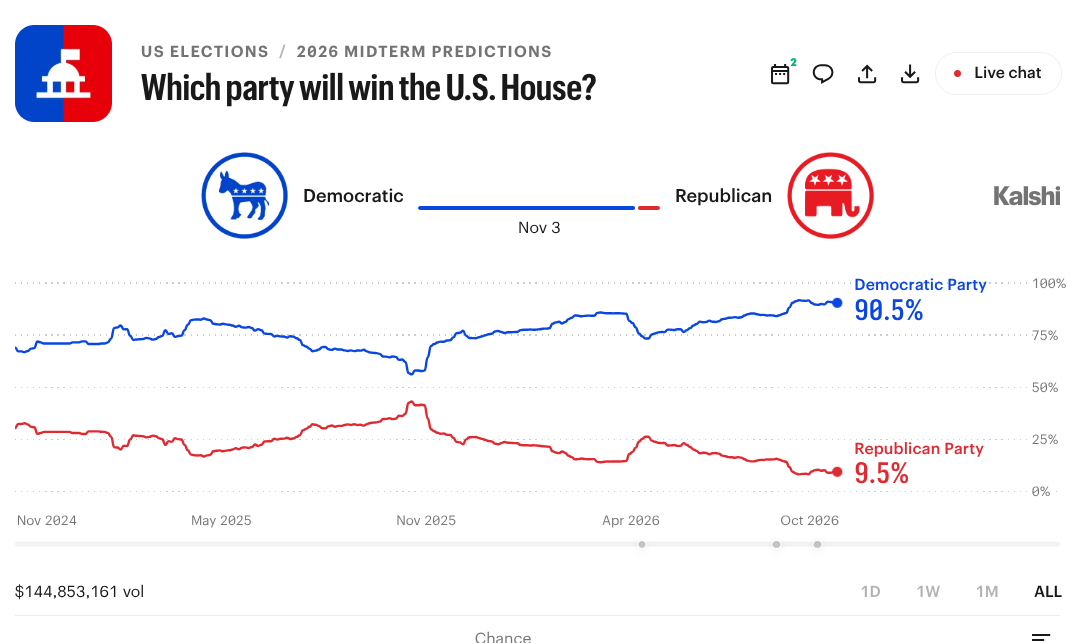
Kalshi's House control market shows a much wider gap than the Senate, with Democrats priced at 90.4% compared with 9.6% for Republicans.
The numbers reflect a difficult defensive landscape for Republicans, who enter Election Day protecting a narrow House majority. With 218 seats needed for control, even a relatively small number of district-level flips could change the balance of power.
Cook Political Report's October 23 ratings identify 17 toss-up races, including 12 Republican-held seats and five Democratic-held seats. That imbalance helps explain the market's pricing, although Democrats must still defend vulnerable incumbents while pursuing Republican-held districts.
The national market price is striking, but the outcome will be determined district by district. Five contests capture different dimensions of that fight:
- Texas' 15th District: Republican Rep. Monica De La Cruz faces Democrat Bobby Pulido in South Texas. Their contest has attracted approximately $3.22 million in Kalshi trading volume, the most of any individual House race so far. Cook rates the district a toss-up. The volume highlights trader attention, though it should not be mistaken for a measure of how close the vote will be.
- North Carolina's 1st District: Democratic Rep. Don Davis faces Republican Laurie Buckhout. The district's redrawn boundaries have made it a major Republican target, and outside groups have committed substantial resources to the contest. As a Democratic-held toss-up, NC-01 is a reminder that gaining seats elsewhere will not be enough if Democrats lose ground in their own competitive districts.
- New York's 17th District: Republican Rep. Mike Lawler faces Democrat Cait Conley in the Hudson Valley. The race has attracted tens of millions of dollars in candidate and outside spending, reflecting the national attention devoted to competitive suburban districts. Cook rates it a toss-up, placing another Republican-held seat in the broader battle for the majority.
- Michigan's 10th District: Republican Michael Bouchard and Democrat Christina Hines are competing for the open seat vacated by John James. Outside spending has exceeded $26 million, with major investment benefiting both parties. The race illustrates how an open seat can become a national battleground even without an incumbent defending it.
- California's 22nd District: Republican Rep. David Valadao faces Democrat Randy Villegas in a district affected by California's revised congressional map. Cook rates the race a toss-up. Its significance extends beyond the candidates: the contest is part of a wider redistricting battle that has reshaped the competitive landscape ahead of November.
Pennsylvania's 8th District also deserves attention. Republican Rep. Rob Bresnahan faces Democrat Paige Cognetti in a heavily contested northeastern Pennsylvania race. A New York Times/Philadelphia Inquirer/Siena survey conducted October 16-22 measured Cognetti at 51% and Bresnahan at 46%, within its 5.7-point margin of error. Substantial spending and close polling make PA-08 another important piece of the House battlefield.
What to Watch Before the 2026 Midterm Elections
The final week offers several developments that could change how traders price congressional control.
- Congress: Watch whether the gap between a Democratic sweep and split control narrows or widens. The combined market can reveal shifts in expectations that are less obvious when examining the chambers separately.
- Senate: New polling, early-voting information, and late campaign developments in Texas, Maine, Michigan, Ohio, and Iowa could influence prices. With Democrats needing a net four-seat gain, individual state races carry considerable weight.
- House: Watch for late shifts in closely contested Republican-held districts such as NY-17, MI-10, and CA-22, alongside Democratic defenses like NC-01. With 12 Republican-held seats among Cook's 17 toss-ups, even modest changes across a handful of races could reshape the fight for the majority.
Prediction markets have spent months pricing the possibilities. On November 3, voters begin delivering the answers. The results will determine whether Congress operates under unified or divided control, clearly setting the stage for the next two years in the nation’s capital.