
2026 Nobel Peace Prize Prediction Market: Wide Open Ahead of Friday's Announcement
With the 2026 Nobel Peace Prize announcement approaching, prediction markets show a crowded field led by humanitarian organizations and advocates, with no candidate holding a commanding advantage.
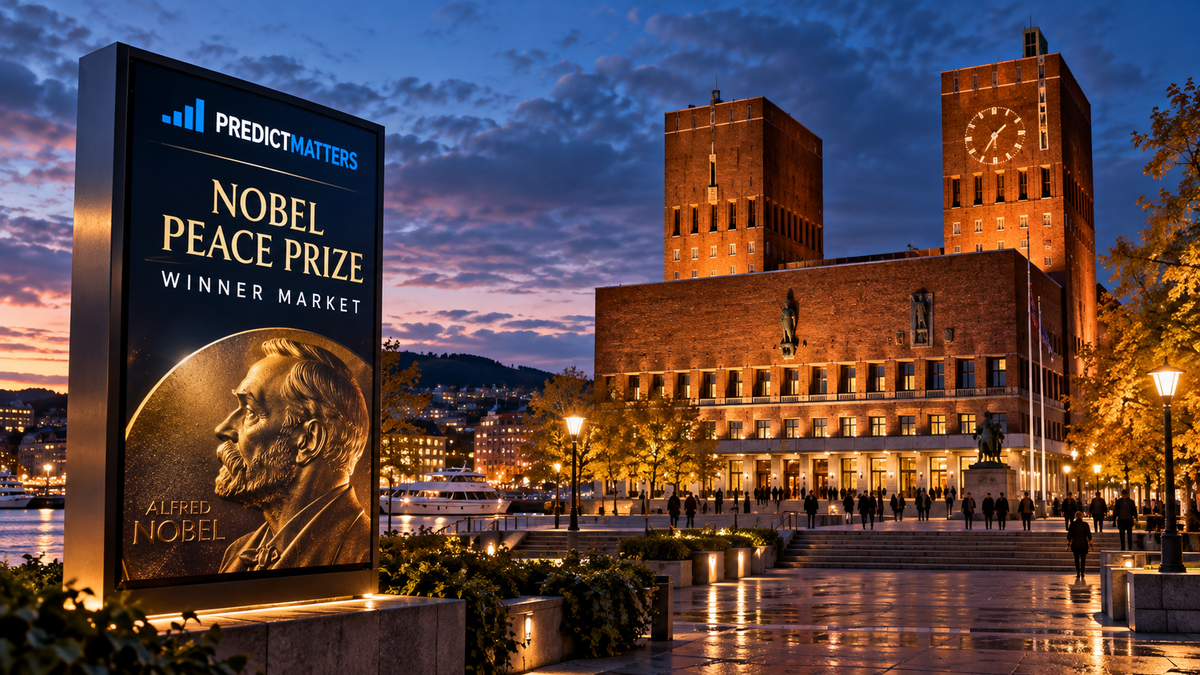
The countdown is on in Oslo, but prediction markets have yet to settle on a clear favorite for the 2026 Nobel Peace Prize.
With Friday's announcement approaching, the market reflects considerable uncertainty about who will receive one of the world's most closely watched international honors.
Market Snapshot
- Sudan's Emergency Response Rooms: 16%
- Mykola Kuleba / Save Ukraine: 10%
- Save the Children: 7%
- Yulia Navalnaya: 5%
- International Court of Justice: 4%
- Volume: $4.12M+
- Announcement: Friday, Oct. 9, 2026
- Location: Oslo, Norway
- Prediction market prices as of 6 a.m. EDT Thursday, Oct. 8, 2026.
Quick Brief
The Nobel Peace Prize recognizes individuals and organizations for work advancing peace, international cooperation, and related humanitarian efforts. Its selection process also creates an unusual challenge for prediction markets: the Norwegian Nobel Committee keeps nominations and deliberations confidential, leaving traders with limited direct information about its decision.
That uncertainty is reflected in this year's market. No candidate has reached 20%, and the five leading entries account for just 42 percentage points of the board's displayed probabilities.
The leaders also tell an interesting story. Rather than concentrating on prominent political figures, the market's upper tier includes organizations addressing humanitarian emergencies, protecting children, and pursuing international justice.
With the announcement less than a day away, the question is whether the committee will recognize one of these efforts or deliver a result that few traders anticipated.
Who's leading the Nobel Peace Prize market?
Sudan's Emergency Response Rooms (16%) occupy the top position. These volunteer-led networks provide food, medical assistance, and other emergency services to communities affected by Sudan's civil war. Their work has attracted international recognition as an example of locally organized humanitarian relief amid an ongoing conflict.
Mykola Kuleba / Save Ukraine (10%) are next. Kuleba, a Ukrainian children's rights advocate, leads an organization working to rescue and reunite children affected by Russia's invasion. The broader protection of children in conflict zones is also represented by Save the Children (7%), which operates humanitarian and child-protection programs internationally.
Both Sudan's Emergency Response Rooms and children's rights advocacy feature prominently in the Peace Research Institute Oslo's independent assessment of possible 2026 recipients. Its September list highlighted Kuleba alongside Save the Children, although that assessment is not affiliated with the Nobel Committee.
Yulia Navalnaya (5%), the widow of Russian opposition leader Alexei Navalny, is another leading individual contender. She has continued advocating for democratic change in Russia following her husband's death in 2024.
Rounding out the top five is the International Court of Justice (4%), the United Nations' principal judicial body, which resolves legal disputes between states and issues advisory opinions on questions of international law.
Together, the leading entries illustrate how broadly the market interprets the potential direction of this year's award.
A crowded field beyond the favorites
The deeper board includes several organizations with established humanitarian or international roles.
Doctors Without Borders and the Committee to Protect Journalists each sit at 3%, while the International Criminal Court, UNRWA, and the International Space Station partnership also appear among the available contracts. The latter is an unconventional possibility, reflecting the role of international scientific cooperation rather than traditional conflict mediation.
Prominent public figures appear farther down the board. Canadian Prime Minister Mark Carney is priced at 1.9%, while President Donald Trump and Pope Leo XIV each sit at approximately 1%.
Trump has publicly discussed his desire to receive the prize, but his prominence in political debate has not translated into a leading position in this market.
An important distinction: the market's candidate list is not an official Nobel shortlist. The committee has confirmed 287 nominations for 2026, including 208 individuals and 79 organizations, but does not disclose their identities for 50 years.
What to Watch
- Friday's announcement: The Norwegian Nobel Committee will reveal its decision at 11 a.m. local time in Oslo (5 a.m. EDT).
- A possible surprise: With the leading contract at only 16%, the market assigns considerable probability to outcomes beyond its top-ranked entry.
- Humanitarian recognition: Several of the leading contracts concern relief work and protecting people affected by conflict, making the committee's chosen focus particularly noteworthy.
- The official decision: Public speculation and independent expert lists provide context, but neither reveals the committee's confidential deliberations.
The 2026 Nobel Peace Prize market enters its final hours without a commanding favorite.
Humanitarian organizations and advocates lead the board, but the range of possibilities remains broad. Friday's announcement will settle a question that millions of dollars in trading have yet to resolve decisively.
For readers new to event contracts, see our guide to what prediction markets are and how they work.