Crypto Prediction Markets: Trading on Bitcoin Prices & Beyond
Explore how crypto prediction markets work, from Bitcoin and Ethereum price contracts to short-term trading, perpetual futures, and settlement rules.

Crypto prediction markets give traders a different way to follow Bitcoin, Ethereum, and the wider cryptocurrency industry. Instead of buying digital assets, traders can take positions on specific outcomes, from whether Bitcoin will rise over the next 15 minutes to whether it will reach a major price milestone before a deadline.
The range of contracts extends well beyond Bitcoin's next move. Some markets track Ethereum and other cryptocurrencies, while others cover token launches, exchange listings, and blockchain developments. Trading platforms also offer different products, including short-duration event contracts and perpetual futures.
Understanding these differences is essential. A prediction about Bitcoin's direction is not necessarily the same as a prediction about where its price will finish, and the rules governing each contract determine what counts as a winning outcome.
Key Takeaways
- Crypto prediction markets let traders take positions on cryptocurrency prices and other defined outcomes without necessarily owning the underlying assets.
- Bitcoin and Ethereum are major subjects, alongside contracts covering other cryptocurrencies, token-related developments, and blockchain events.
- Trading formats vary, including Yes/No price thresholds, price ranges, milestones, and short-term Up/Down markets.
- Contract details matter. Deadlines, reference prices, settlement sources, and observation periods can determine whether a seemingly correct prediction pays out.
- Not every crypto trading product is a prediction contract. Perpetual futures offer a different structure involving margin, leverage, and ongoing exposure to price movements.
What Are Crypto Prediction Markets?
Crypto prediction markets are marketplaces where traders buy and sell contracts tied to cryptocurrency-related outcomes. Rather than purchasing Bitcoin or Ethereum directly, participants trade positions based on whether a specified event will occur.
A contract might ask whether Bitcoin will finish above $100,000 on a particular date, whether Ethereum will rise over the next hour, or whether a cryptocurrency will reach a new price milestone before year-end.
These markets generally fall into two categories: contracts tied to cryptocurrency prices and contracts tied to events involving digital assets, exchanges, or blockchain networks.
There is also an important distinction between crypto prediction markets and crypto-based prediction platforms. The former describes what traders are predicting. The latter refers to platforms that use cryptocurrency or blockchain infrastructure to facilitate trading, potentially across unrelated subjects such as politics, sports, and entertainment.
A prediction market about Bitcoin does not necessarily operate on a blockchain, and a blockchain-based prediction platform does not necessarily specialize in cryptocurrency outcomes.
How Do Crypto Prediction Markets Work?
Most conventional crypto prediction markets use event contracts with defined settlement conditions. Traders take positions on whether a particular outcome will occur, and prices change as participants reassess its likelihood.
A typical Yes/No contract trades between $0 and $1, with its price serving as an approximate measure of the market's implied probability.
Consider a hypothetical contract asking whether Bitcoin will finish above $100,000 on December 31.
- If Yes trades at 40 cents, the market is pricing that outcome at approximately a 40% probability.
- A trader purchasing 10 Yes contracts for $4 would receive $10 if the contracts settle Yes, producing a $6 gross profit before fees.
- If the outcome does not occur, those contracts would expire worthless.
Traders do not necessarily have to hold positions until settlement. Many markets allow positions to be sold before expiration, although the available price depends on trading activity and liquidity.
Some contracts offer multiple possible outcomes rather than a simple Yes/No proposition. For example, a market might divide Bitcoin's settlement price into several ranges, with each range representing a different possible result.
The underlying principle remains the same: traders are taking positions on defined outcomes, not simply buying or selling cryptocurrency.
For a broader introduction to event contracts, probabilities, and trading mechanics, see our guide to prediction markets.
What Can You Trade in Crypto Prediction Markets?
Crypto prediction markets cover a variety of assets, outcomes, and timeframes. Bitcoin is a major focus, but the available contracts extend to Ethereum, other cryptocurrencies, short-term price movements, and events affecting the broader industry.
The key differences are often found in the contract structure. Two markets concerning the same cryptocurrency can have entirely different winning conditions.
Bitcoin Prediction Markets
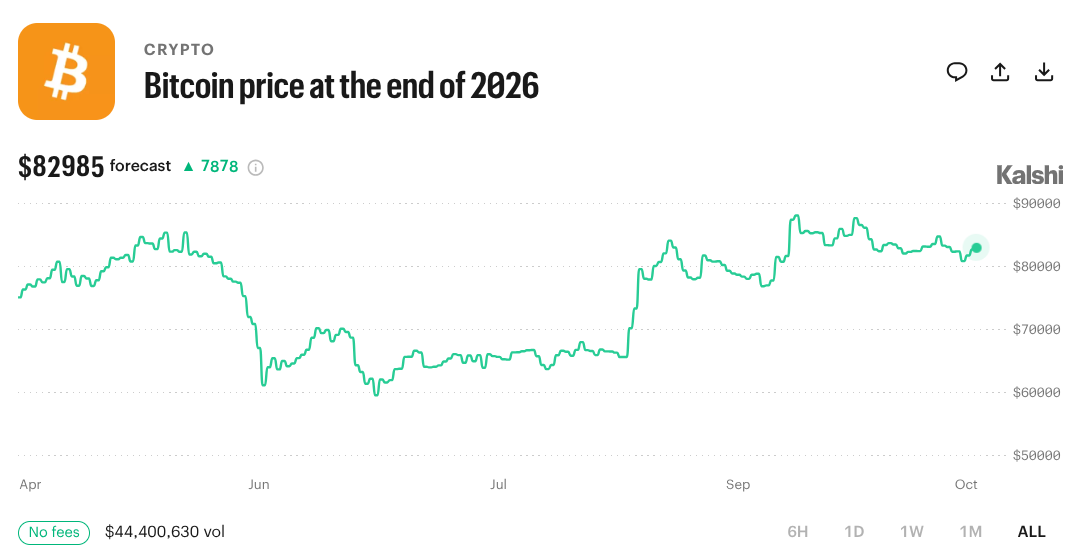
Bitcoin prediction markets allow traders to take positions on where BTC prices are headed, whether specific thresholds will be reached, and how the cryptocurrency will perform over defined periods.
Some contracts focus on Bitcoin's price at a particular deadline. Others ask whether BTC will touch a specified level at any point before expiration, or how high or low its price will move during a given period.
Common Bitcoin market formats include:
- Price thresholds: Whether Bitcoin will finish above or below a designated price at a specified time.
- Price ranges: Which price band Bitcoin will occupy when the contract settles.
- Price milestones: Whether Bitcoin will reach a particular level before a deadline.
- Highs and lows: Whether Bitcoin will record a specified high or low during a defined period.
- Short-term direction: Whether Bitcoin will rise or fall over a brief trading window.
These distinctions can produce very different results, even when the underlying cryptocurrency moves in the direction a trader expected.
Suppose Bitcoin begins a month at $95,000 and finishes at $98,000. Someone expecting BTC to rise would have correctly anticipated its general direction, but a contract requiring Bitcoin to finish above $100,000 would still settle No.
Conversely, a contract asking whether Bitcoin would reach $100,000 at any point during the month could settle Yes if the threshold was touched, even if BTC subsequently declined.
Bitcoin's price movement matters, but the precise outcome being traded matters just as much.
Ethereum and Altcoin Prediction Markets
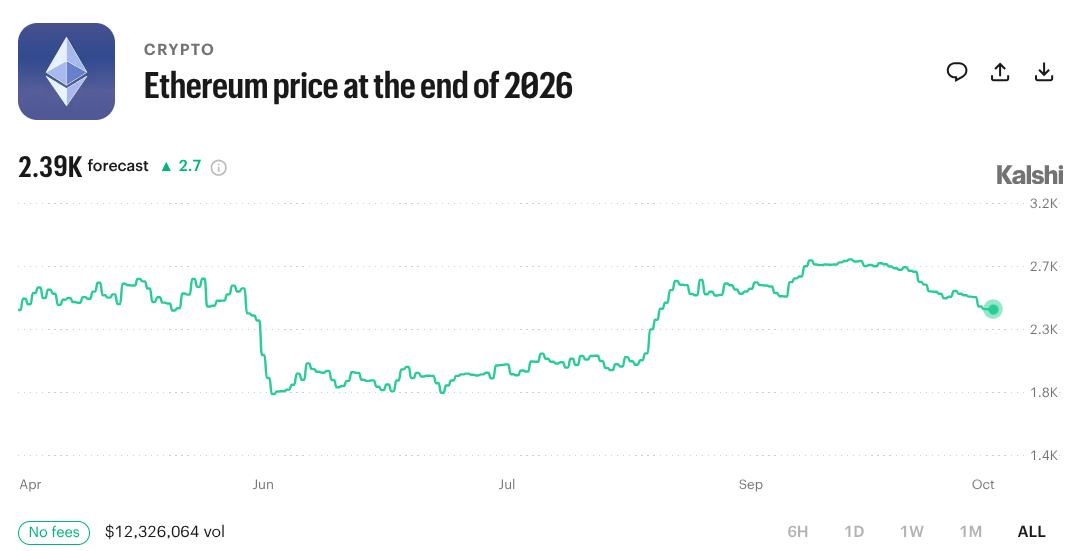
Ethereum prediction markets apply many of the same formats to ETH, including price thresholds, ranges, milestones, and directional contracts.
Traders may also find markets involving other cryptocurrencies, including Solana and XRP. The selection depends on the exchange, and not every asset supports the same range of contracts or trading intervals.
Ethereum and altcoin markets can respond to many of the same forces affecting Bitcoin, including broader crypto sentiment, institutional demand, and macroeconomic developments. They also have their own catalysts.
An Ethereum network upgrade, for example, may influence expectations for ETH independently of Bitcoin. Developments involving a particular blockchain ecosystem, token, or exchange can likewise affect contracts tied to that asset.
Trading activity is another important distinction. Bitcoin contracts may attract deeper markets than those involving smaller cryptocurrencies, potentially affecting bid-ask spreads and the ability to enter or exit positions.
The presence of a cryptocurrency in an exchange's market directory does not necessarily mean that every contract involving it has substantial liquidity.
Short-Term Crypto Price Markets
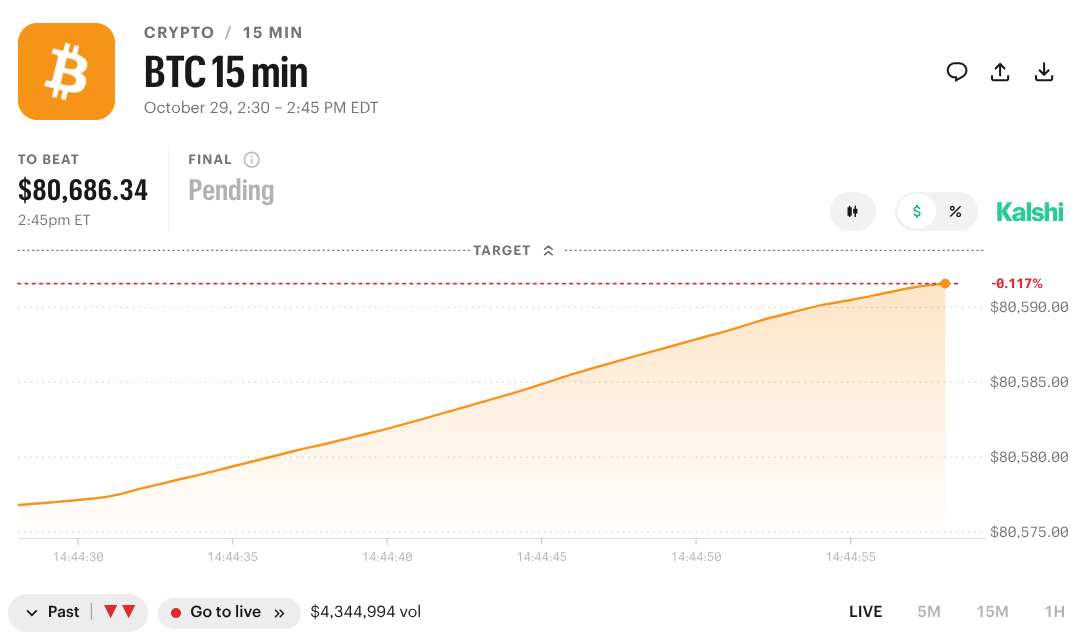
Some of the most distinctive crypto prediction contracts focus on price movements over minutes rather than weeks or months.
Short-duration Up/Down markets ask whether a cryptocurrency's price will finish above or below a designated reference level at the end of a specified interval.
Platforms offer formats including five-minute, 15-minute, hourly, and daily markets, depending on the cryptocurrency and exchange.
Consider a hypothetical 15-minute Bitcoin Up/Down contract.
- If the opening reference price is $100,000 and the closing reference price is $100,025, the Up outcome wins under rules requiring the closing price to exceed the opening price.
- If the closing reference price is $99,975, the Down outcome wins.
- The contract's exact rules determine how ties and reference prices are handled.
Unlike a year-end Bitcoin forecast, a 15-minute contract is concerned with a very narrow slice of price action. A trader can be bullish on Bitcoin's long-term prospects while expecting it to decline during a particular short-term interval.
These contracts also make timing and settlement methodology especially important.
For example, some exchanges calculate opening and closing reference prices using averages of index observations rather than a single spot-price reading. That means the price displayed on a cryptocurrency exchange at one instant may not be the value used to settle the prediction contract.
Short-term markets can move rapidly as expiration approaches. Even relatively small changes in the underlying cryptocurrency may determine the outcome, while liquidity and spreads can materially affect trading results.
Other Crypto Prediction Markets You Can Trade
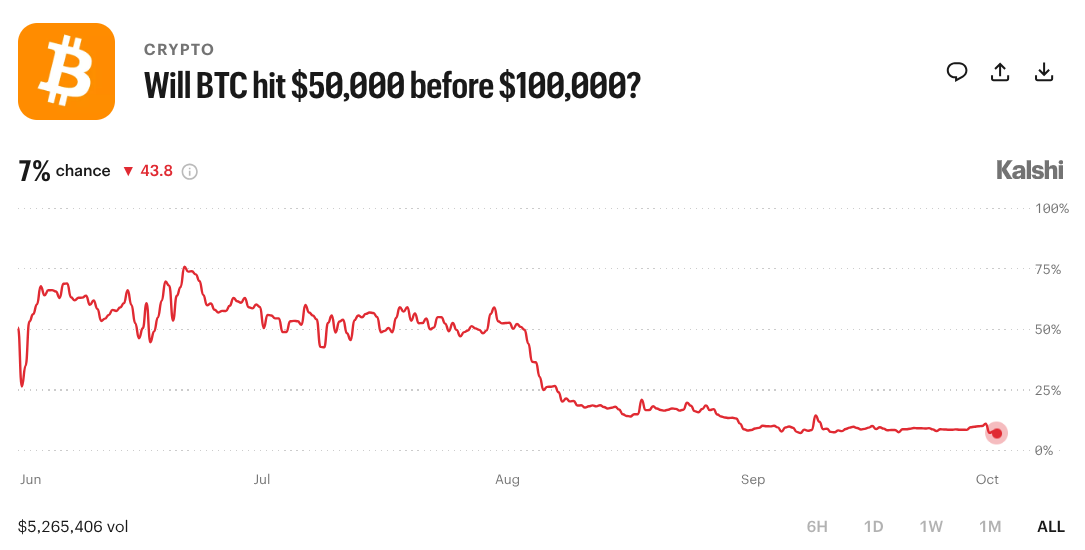
Not every crypto prediction market is organized around a particular cryptocurrency's next price movement. Exchanges also list contracts covering broader price outcomes and developments across the digital asset industry.
Examples include:
- Above/below price markets: Contracts asking whether a cryptocurrency will be above or below a specified threshold at a designated time.
- Price range markets: Contracts dividing possible settlement prices into defined bands, allowing traders to take positions on where an asset will finish.
- Price milestones and highs/lows: Markets tracking whether a cryptocurrency reaches a target or records a particular high or low during a specified period.
- Token launches and exchange listings: Contracts concerning whether a new token launches or becomes available on a specified trading platform before a deadline.
- Blockchain events: Markets tied to measurable developments, such as network upgrades, protocol milestones, or other defined industry events.
These markets can involve very different kinds of analysis. A price-range contract depends on where an asset finishes, while a token-listing contract may depend on an announcement or a verifiable exchange event.
The common thread is a defined outcome with rules establishing what must happen for the contract to settle.
How Do Perpetual Prediction Markets Work?

Perpetual futures offer another way to trade cryptocurrency price movements, but they are separate derivatives products rather than conventional prediction market contracts.
Kalshi offers perpetual futures alongside its event-contract markets. Unlike a Yes/No prediction contract with a defined outcome and expiration date, a perpetual future provides ongoing exposure to an underlying asset's price movements without a fixed expiration.
Traders can take long positions when they expect prices to rise or short positions when they expect prices to fall.
Several features distinguish perpetual futures from standard crypto prediction contracts:
- No fixed expiration: Positions can remain open until the trader closes them or they are liquidated under applicable rules.
- Margin and leverage: Traders can control positions larger than the funds committed as margin, amplifying both gains and losses. Kalshi uses a separate margin account for perpetual futures rather than the balance used for conventional prediction contracts.
- Funding payments: Kalshi calculates funding every eight hours, with payments between long and short positions helping keep perpetual futures prices aligned with underlying reference markets. Depending on the funding rate and position, traders may pay or receive funding.
- Liquidation risk: Positions may be forcibly closed when margin falls below required levels. Under extreme market conditions, losses can exceed the initial margin committed.
- Different profit and loss mechanics: Returns depend on changes in the position's value, funding payments, and trading costs rather than a fixed $1 payout for a correct Yes/No prediction.
Kalshi's perpetual products cover several cryptocurrencies, including Bitcoin and Ethereum.
The distinction is especially important for traders moving between products on the same platform. A conventional fully funded Yes/No contract generally has a maximum loss determined by its purchase cost and applicable fees. A leveraged perpetual future introduces margin requirements, funding costs, and liquidation exposure.
Perpetual futures should therefore be understood as a separate derivatives product, not simply prediction contracts without an expiration date.
What Moves Crypto Prediction Market Prices?
Crypto prediction market prices respond to developments in the underlying cryptocurrency markets, but the relationship is not always straightforward.
A sharp Bitcoin rally may increase the probability of a bullish price target, for example, while doing relatively little for a contract requiring a much higher milestone before a rapidly approaching deadline.
Several factors influence how these markets are priced:
- Underlying cryptocurrency prices: Bitcoin, Ethereum, and other asset prices provide the most immediate reference points for price-dependent contracts. Movements toward or away from a threshold can change implied probabilities.
- Volatility and market conditions: Rapid price swings, momentum, and changing expectations for future volatility can affect the likelihood of reaching a particular level.
- Economic and regulatory developments: Federal Reserve decisions, inflation reports, government policy, and regulatory announcements can influence cryptocurrency prices and expectations.
- Crypto-specific developments: Exchange news, ETF-related developments, institutional activity, network upgrades, and major industry announcements can shift expectations for individual assets.
- Time remaining and liquidity: A distant price target may be plausible with six months remaining but unlikely with 15 minutes left. Thin trading and wide spreads can also cause quoted contract prices to differ from broader market expectations.
The important distinction is between a view about cryptocurrency and a view about a particular contract.
A trader may believe Bitcoin is undervalued over the long term while assigning a low probability to a specific near-term milestone. Likewise, a market can price a short-term decline as likely without signaling a broader bearish outlook.
Prediction market prices reflect expectations about defined outcomes, not a single universal forecast for an asset.
How Do Crypto Prediction Markets Settle?
Crypto prediction contracts settle according to their published resolution rules. Those rules identify the outcome being measured, the relevant deadline or observation period, and the data source used to determine the result.
For price-based markets, the settlement source is particularly important.
Kalshi uses CF Benchmarks indices for many cryptocurrency price contracts, with certain markets calculating settlement values from observations collected during a specified period rather than a single instantaneous quote.
For example, a 15-minute Up/Down contract may compare an averaged opening reference price with an averaged closing reference price. The result can differ from a quick comparison of two prices displayed on a retail cryptocurrency exchange.
Contract wording also determines whether reaching a threshold is sufficient.
A market asking whether Bitcoin will reach $100,000 before December 31 is different from one asking whether Bitcoin will finish above $100,000 on December 31. The first concerns whether the milestone occurs during the observation period. The second concerns the specified settlement value at the deadline.
For event-based markets, settlement may instead depend on a documented token launch, exchange listing, network event, or other qualifying development.
Exchanges publish rules governing how results are determined, including applicable procedures for unusual circumstances. Because sources and methodologies vary, traders should review the specific contract rather than assume all crypto markets settle using the same price feed or criteria.
Crypto Prediction Markets vs. Buying Cryptocurrency
Crypto prediction markets and traditional cryptocurrency investing can involve views about the same assets, but they provide fundamentally different exposures.
Buying Bitcoin gives an investor exposure to the value of Bitcoin itself. Buying a Bitcoin prediction contract provides exposure to a particular outcome involving Bitcoin, usually subject to a defined deadline or observation period.
The difference becomes especially clear when a cryptocurrency moves in the expected direction but fails to meet a contract's requirements.
Bitcoin could gain 10% over a month while a contract predicting a 20% increase settles No. A spot Bitcoin holder would have benefited from the rise, while someone holding the unsuccessful prediction contract through settlement would lose the amount committed to that position.
Neither structure is inherently interchangeable with the other. They serve different purposes and involve different trading considerations.
Perpetual futures introduce a third form of exposure, combining directional price trading with leverage, margin, and funding mechanics.
Where Can You Trade Crypto Prediction Markets?
Several trading platforms offer cryptocurrency-related contracts, although their available assets, market formats, fees, and access requirements differ.
- Kalshi operates a CFTC-regulated exchange offering Bitcoin and other cryptocurrency prediction markets. Its crypto category includes price-based contracts, short-duration markets, and related outcomes. Kalshi also offers perpetual futures as a separate derivatives product. Readers can explore its current listings through the Kalshi crypto markets directory.
- Polymarket US offers cryptocurrency prediction contracts, including short-term directional markets involving Bitcoin, Ethereum, and other assets. Current listings can be viewed at Polymarket US. Its domestic platform must be distinguished from Polymarket's international service, which may offer a different selection of markets and operates under different access arrangements. Contracts visible on the international platform should not be assumed available to US users.
Other exchanges offer crypto-related event contracts, but market selection and trading activity vary. Readers should compare actual listings, trading costs, liquidity, and resolution rules rather than assume that all prediction platforms provide equivalent cryptocurrency coverage.
For a broader comparison of where you can trade, see our guide to the best prediction market platforms.
Are Crypto Prediction Markets Legal?
Crypto prediction markets operate within a regulatory framework that depends on the exchange, the financial product, and the trader's jurisdiction.
In the United States, the Commodity Futures Trading Commission (CFTC) oversees federally regulated derivatives markets, including designated contract markets offering certain event contracts. Kalshi and Polymarket US operate as CFTC-designated contract markets.
However, the regulatory status of an exchange does not mean every product is available to every U.S. resident. Trading restrictions, product eligibility, and jurisdiction-specific rules can affect access.
It's also important to distinguish conventional crypto event contracts from spot cryptocurrency trading and leveraged derivatives such as perpetual futures. These products have different structures and may be subject to different regulatory requirements.
Readers should review the exchange's current eligibility rules and the terms of the particular product before trading.
Trading Crypto Prediction Markets
Crypto prediction markets offer numerous ways to express views about digital assets, but understanding the underlying cryptocurrency is only part of the equation.
Four considerations are particularly important:
- Read the contract carefully. Identify the exact outcome, deadline, reference price, settlement source, and any conditions affecting resolution.
- Evaluate trading costs and liquidity. Fees, bid-ask spreads, and available order-book depth can materially affect returns, particularly when trading frequently or exiting early.
- Account for volatility. Crypto prices can change sharply, and short-duration contracts may swing rapidly between high and low implied probabilities.
- Match the market to the timeframe. A 15-minute directional contract, a monthly price threshold, and a year-end milestone each represent a different question about the same asset.
A sound understanding of Bitcoin or Ethereum does not automatically translate into a successful prediction contract. The outcome must occur under the contract's precise rules, and the price paid for the position matters.
The central principle is simple: in crypto prediction markets, getting the contract right is as important as getting the cryptocurrency's direction right.
Crypto Prediction Markets FAQs
Can you trade crypto prediction markets 24/7?
Yes, crypto prediction markets are available around the clock, although trading schedules vary by platform. Kalshi operates 24/7 except for scheduled maintenance on Thursdays from 3–5 a.m. ET. Individual contracts also have their own expiration times, so a 15-minute Bitcoin market closes at the end of its trading window, while new contracts provide opportunities to trade subsequent price movements.
What happens if Bitcoin reaches a price target before the deadline?
It depends on the contract. A milestone market may settle Yes if Bitcoin reaches the specified price at any point during the eligible period. A contract asking whether Bitcoin will finish above that level at a particular time generally requires the designated settlement price to satisfy the threshold. Touching the price earlier may not be enough.
Can you trade both rising and falling cryptocurrency prices?
Yes. Conventional prediction markets can offer positions on upward or downward price outcomes through Yes/No contracts and directional markets. For example, a trader expecting Bitcoin to fall could take a position on a Down outcome or against a specified bullish threshold, depending on the market structure. These positions are not necessarily equivalent to short-selling Bitcoin or trading leveraged derivatives.
Can you sell a crypto prediction market position before it settles?
Many crypto prediction contracts can be sold before settlement, allowing traders to realize gains or losses without waiting for the final outcome. However, exiting depends on available liquidity and the prices other participants are willing to pay. A contract's displayed price does not guarantee that an order of any size can be executed at that level.
What happens if a cryptocurrency price source becomes unavailable?
The outcome depends on the exchange's published rules and the affected contract. Some markets specify procedures for unavailable data, calculation disruptions, or other unusual circumstances. These procedures are not universal, so traders should review the applicable settlement terms and exchange rulebook rather than assume a substitute price source will automatically be used.