October Fed Rate Prediction Markets: Will the Fed Hike Rates Again?
The Fed just raised rates for the first time in more than three years. Prediction markets are nearly split on whether another hike comes in October.
The Federal Reserve has made its first move. Now traders are trying to determine how quickly the next one could arrive.
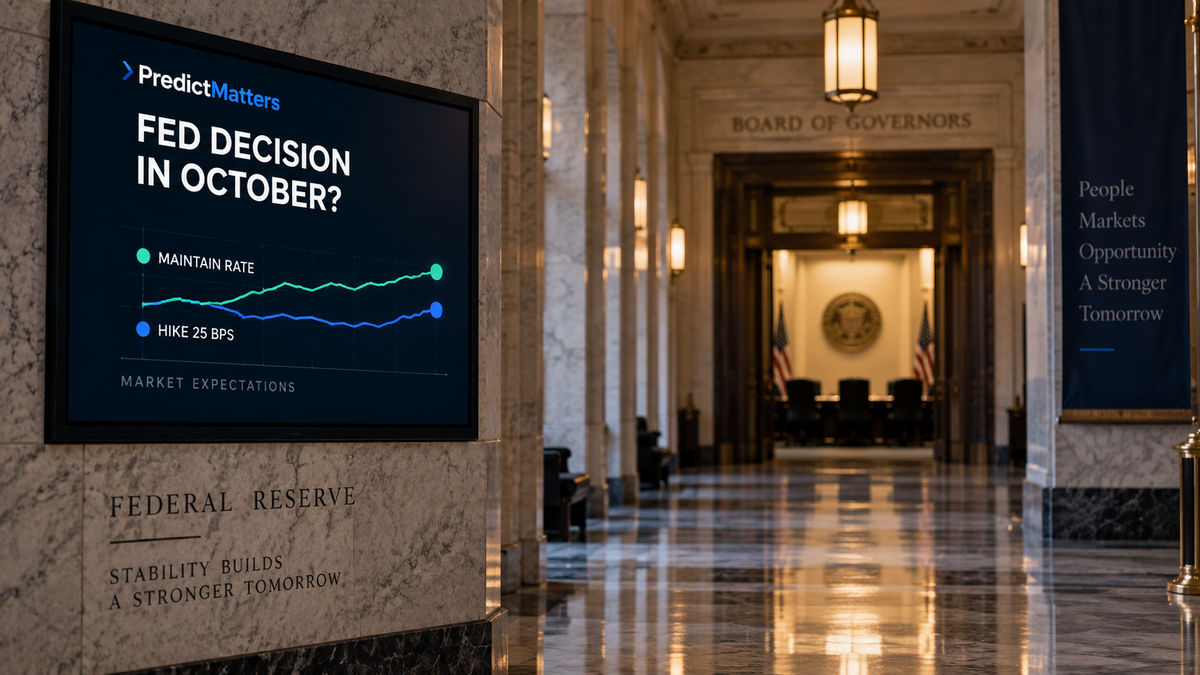
One day after policymakers raised rates by a quarter point, the October Fed decision market is shaping up as a near coin flip between holding rates steady and delivering another 25-basis-point increase.
Market Snapshot
- Maintain rate: 55%
- Hike 25 bps: 46%
- Hike more than 25 bps: 2%
- Cut 25 bps: <1%
- Cut more than 25 bps: <1%
- Volume: $1.61M+
- Next FOMC meeting: Oct. 27–28
- Decision: Oct. 28, 2 p.m. ET
- Prediction market prices as of 9:55 a.m. ET on Sept. 17, 2026.
Quick Brief
The Fed raised its target range by 25 basis points Wednesday to 3.75%–4.00%, its first increase since July 2023. The decision was unanimous, with policymakers pointing to resilient domestic spending, strong productivity and capital investment, steady unemployment, and inflation that remains elevated.
The question now is how quickly the Fed moves again.
Traders on Kalshi give the Fed a 55% probability of maintaining rates at its Oct. 28 meeting, while another quarter-point hike is close behind at 46%. Larger moves in either direction are priced as remote possibilities.
The early October market is concentrated around two outcomes: pause after September's increase, or follow it immediately with another 25-basis-point hike.
The Fed signals more tightening ahead
Wednesday's hike was widely anticipated by the time policymakers gathered, but the accompanying projections provided a clearer look at where the Fed could be headed.
The median FOMC participant now projects the federal funds rate at 4.1% at the end of 2026, up from 3.8% in the June projections. Sixteen of 18 participants project a year-end rate above the midpoint of the Fed's new 3.75%–4.00% range, indicating that most policymakers see at least one additional increase as appropriate this year.
Inflation remains at the center of that shift. The Fed raised its median 2026 projection for PCE inflation from 3.6% in June to 3.7%, while its core PCE projection increased from 3.3% to 3.4%.
At the same time, the median unemployment forecast fell from 4.3% to 4.1%.
Chair Kevin Warsh reinforced the inflation focus after the meeting, saying underlying trends had not meaningfully improved over the summer. He also resisted committing the Fed to a predetermined path, leaving future decisions dependent on how the outlook develops.
The combination creates the central tension in the October market: another hike this year has substantial support inside the Fed, but policymakers have not committed to delivering it at the very next meeting.
October becomes a question of timing
The current market reflects that distinction.
A 55% price for maintaining rates hardly amounts to a strong expectation of a pause, particularly with another 25-basis-point hike sitting at 46%. Cuts are effectively absent from the board, while a hike larger than 25 basis points carries only a 2% probability.
The uncertainty is therefore concentrated less around the Fed's broader direction than around its pace.
Wall Street is already reassessing that timing. Goldman Sachs said Thursday that it now expects another quarter-point hike in October, citing the Fed's updated projections and Warsh's emphasis on persistent inflation.
There’s plenty of runway before policymakers meet again. The next FOMC meeting is scheduled for Oct. 27–28, with the decision due at 2 p.m. ET on the second day.
What to Watch
- Inflation: Wednesday's projections reinforced the Fed's concern about persistent price pressures. Additional inflation readings before Oct. 28 could help determine whether policymakers move again immediately or wait.
- The labor market: Weekly jobless claims unexpectedly fell to 196,000 in Thursday's report, although holiday-related volatility makes the latest reading worth treating cautiously. Continued labor-market resilience could give the Fed more room to focus on inflation.
- Fed messaging: Warsh avoided locking policymakers into a specific path. Speeches from Fed officials between meetings could provide more clues about the appetite for consecutive hikes.
- The 55%-46% divide: The October board begins with no dominant outcome. Watch whether incoming data creates separation between the hold and quarter-point-hike contracts.
The Fed's September decision clarified one part of the outlook: policymakers are willing to raise rates again to combat persistent inflation. Prediction markets suggest the next question is whether they will wait before doing it again.
Want a broader introduction to how these markets work? Our prediction markets guide explains pricing, contracts, trading, and what can move a market.