
How High Will Oil Prices Go in 2026? What Prediction Markets Say
Oil has already climbed above $110 this year, but prediction markets see a more uncertain path to further gains before December 31.

Oil prices remain elevated as geopolitical tensions, disrupted shipping routes, and shifting supply conditions keep energy markets on edge.
West Texas Intermediate (WTI), the U.S. crude oil benchmark, settled at $97.97 per barrel on Thursday, October 15, after climbing more than 3% during the session. Prices remained near $97 in early Friday trading.
With less than three months remaining in 2026, traders on Kalshi are weighing whether oil has already reached its annual peak or another surge could push prices substantially higher.
Oil Price Prediction Market Snapshot
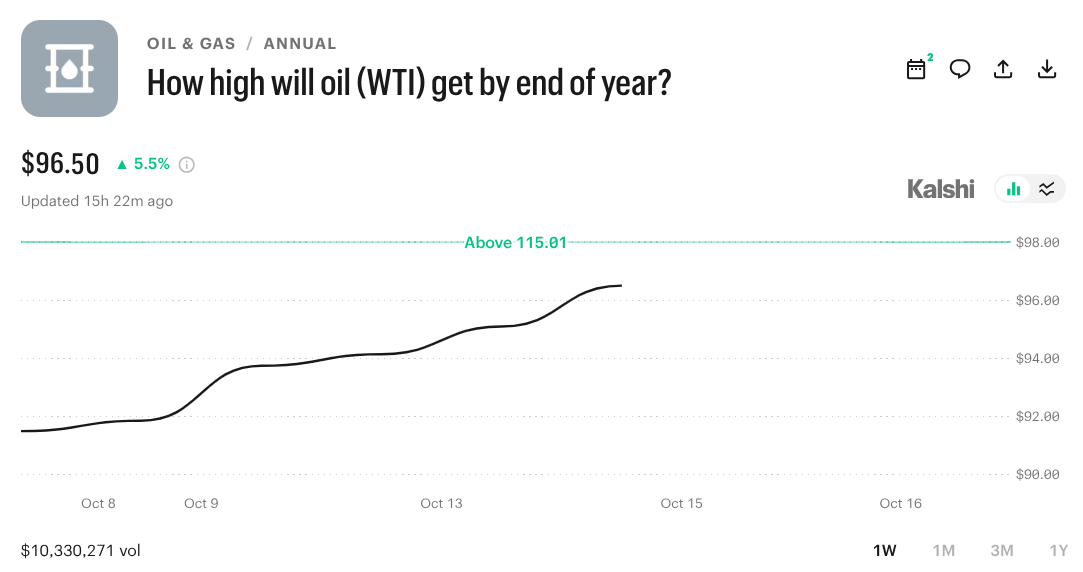
Kalshi market probabilities captured at 5:57 a.m. ET On October 16, 2026. Prices are subject to change. The contracts track the highest daily settlement price of front-month WTI crude futures published by Intercontinental Exchange (ICE). They do not measure the highest intraday trading price or require oil to finish the year above a specified level.
How High Will Oil Go in 2026?
Seven price thresholds, ranging from $80.01 through $110.01, have already been reached this year and are marked Yes on Kalshi. The remaining contracts measure how much higher WTI might climb before the end of December.
The market assigns roughly a one-in-three chance to WTI reaching at least $115.01, a level approximately 17% above Thursday's settlement. Expectations decline further at $120 and $125, suggesting traders see another meaningful rally as possible but far from certain.
At the upper end, probabilities generally fall into single digits, although the $150 and $200 contracts are priced slightly higher than lower thresholds. These inconsistencies can occur across separately traded contracts and should not be interpreted as evidence that higher prices are more likely.
What's Driving Oil Prices?
The oil market is balancing persistent supply risks against efforts to restore production, improve shipping conditions, and ease pressure on global energy prices. Several developments are shaping oil prices and expectations for the remainder of 2026:
- Middle East conflict and the Strait of Hormuz: Attacks on commercial vessels and regional energy infrastructure continue to threaten oil shipments. The Strait of Hormuz is a critical passage for global petroleum supplies, and uncertainty surrounding its reliability has kept a geopolitical risk premium embedded in crude prices.
- Falling U.S. crude inventories: The Energy Information Administration reported an 8.6 million-barrel decline in U.S. crude stockpiles for the week ending October 9, leaving inventories at 415.6 million barrels. The unexpectedly large draw helped push WTI futures more than 3% higher on Thursday, although hurricane-related production disruptions contributed to the decline.
- Emergency reserve releases: The International Energy Agency is accelerating the release of emergency petroleum supplies, including additional diesel stocks. These measures are intended to ease supply constraints and reduce pressure on energy markets, potentially limiting further price increases.
- Recovering exports and potential sanctions relief: Oil flows from the Middle East have improved from earlier disruptions, while the U.S. is considering adjustments to restrictions affecting sanctioned oil tankers. Both developments could help increase available supply or ease transportation bottlenecks.
- EIA raised its oil-price outlook: The EIA raised its outlook earlier this month, projecting Brent crude would average $105 per barrel during the fourth quarter. Brent is a different benchmark from WTI, but the forecast underscores the expectation that global oil prices will remain elevated even as disrupted supply routes gradually recover.
What to Watch Through Year-End
The next major question is whether supply disruptions intensify enough to propel WTI above the $115 threshold that has so far remained out of reach.
Further attacks on shipping routes, renewed damage to energy infrastructure, or another sharp tightening in inventories could increase expectations for a late-year rally.
Conversely, improved tanker traffic, additional emergency supplies, or diplomatic progress in the Middle East could reduce the risk premium currently supporting crude prices.
With the $110 level already in the books, the remaining contracts offer a measure of how much additional upside traders expect, as well as a window into how much uncertainty still surrounds the final months of 2026.